Locale 3: Kyoto (Part 1)
Day 4: Cultural Exploration in Kyoto
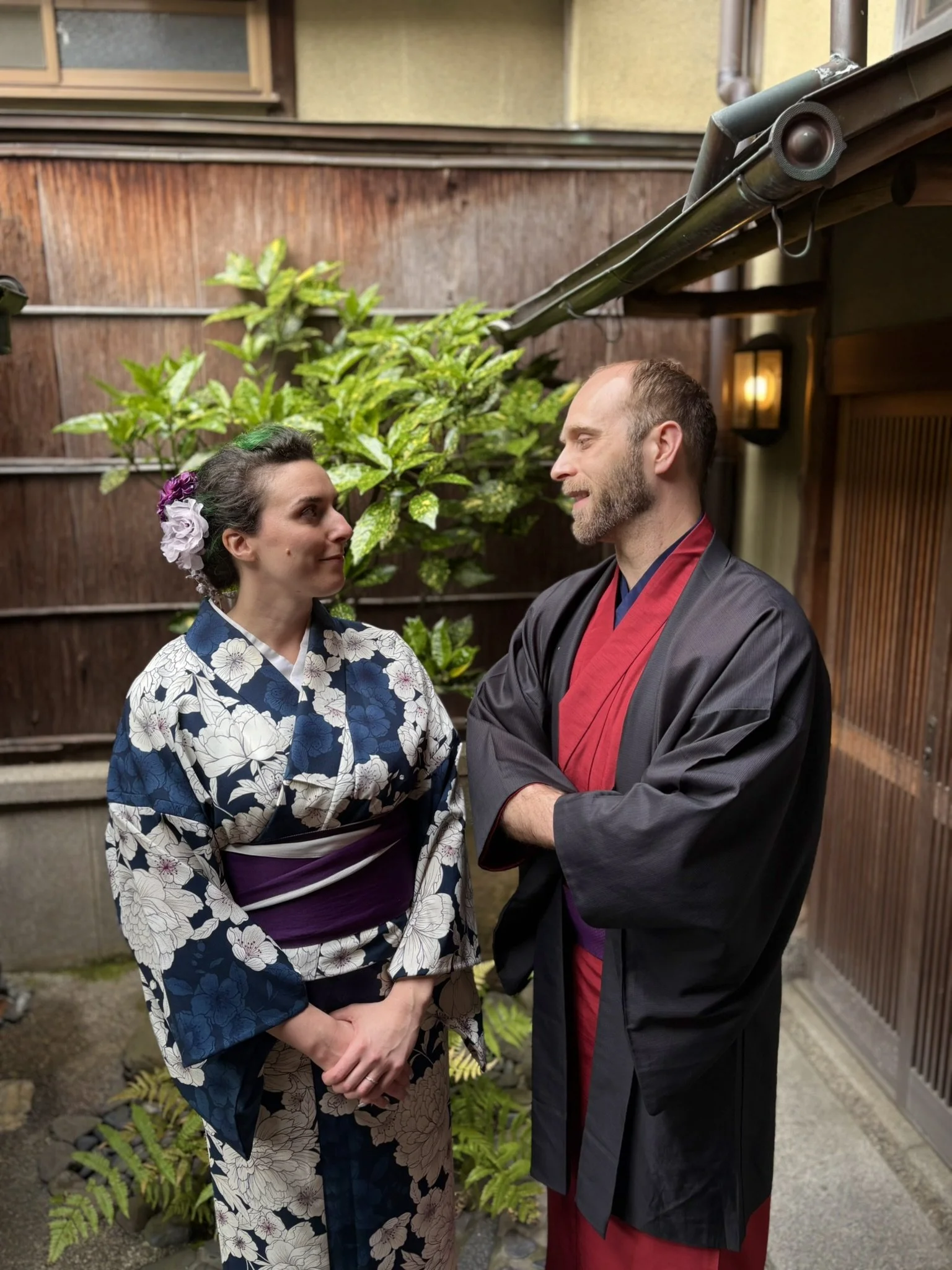
One of my favorite things about this little photoshoot is that we independently picked matching purple belts. :)
May 12
Steps walked: 22,661
Flights of stairs climbed: 74
I would’ve stayed at our Izu ryokan the entire two weeks if I could afford it (but I can’t lol). So, around noon, we hopped on a train to our next destination: Kyoto.
Kyoto is the cultural capital of Japan, and it feels like you can’t throw a rock without hitting half a dozen UNESCO World Heritage sites. The city is also full of tourists, and I mean full—this was the one place in Japan that I genuinely felt kind of bad for the local residents. There isn’t a subway like other cities (the infrastructure doesn’t support it, kind of like Rome) and the buses are crowded and constantly running late from people lugging heavy suitcases or just generally not knowing how to use them. And the residential neighborhoods are full of signs notifying visitors, “Hey! We know the buildings are pretty, but people actually live here! Don’t take pictures and especially don’t come inside!”
Yeesh. That being said, I did really like Kyoto and the surrounding areas—there is PLENTY to explore here, especially if you like hanging out in nature.
Our second hotel: Onyado Nono Kyoto Shichijo
I picked a variety of hotel types during our trip—everything except a capsule hotel (because I figured Jeff literally wouldn’t fit in one). Onyado Nono is a hotel chain themed kind of like a ‘modern’ ryokan. Ours had a hot spring onsen with like 12 different kinds of baths, plus a sauna and steam room. It actually gave me the vibe of one of those all-inclusive resorts just from the amount of random handouts and fun amenities: soba noodles from 9-11PM, mini-bottles of yogurt drink in the morning, and ice cream treats in the afternoon. All for like $140 a night (I hate hotels in the US lol).
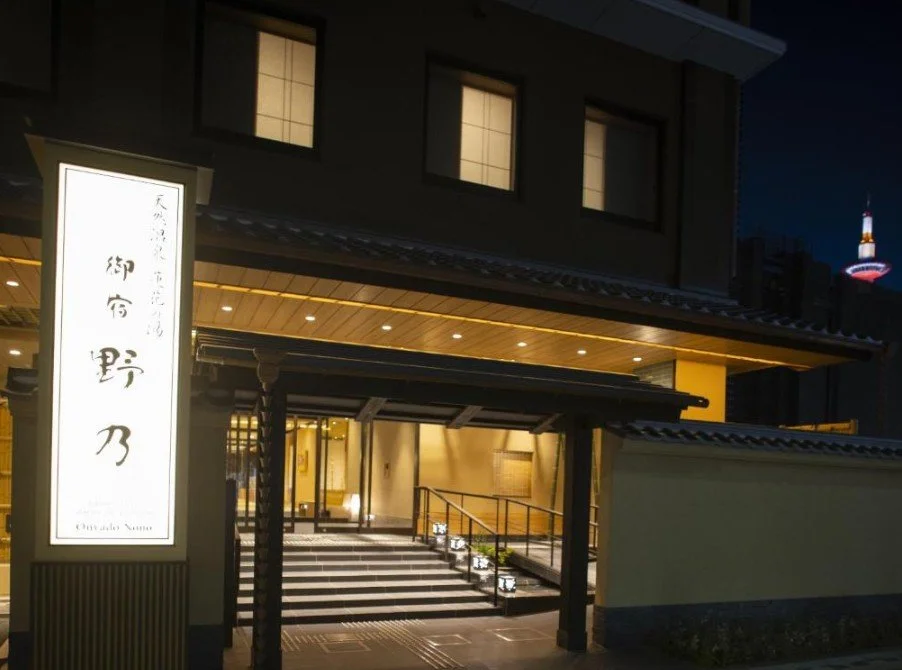
The front walk. When you enter, you have to roll your luggage over a cleaning pad and remove your shoes.
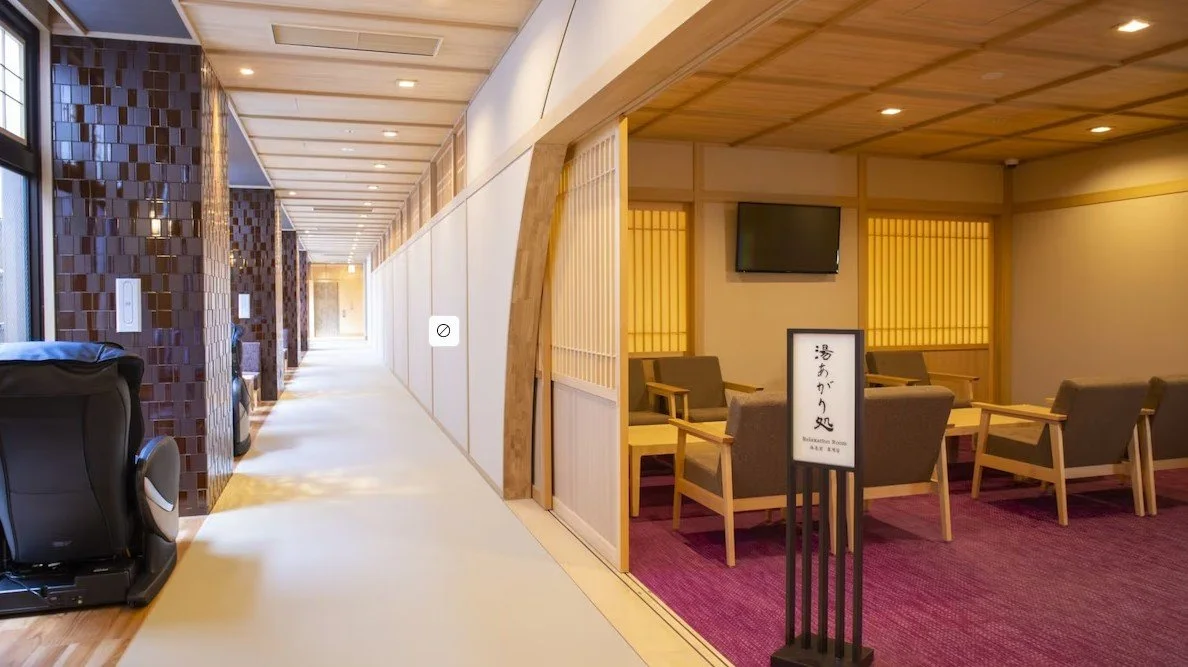
The lounge outside the onsen where the massage chairs and ice cream were.
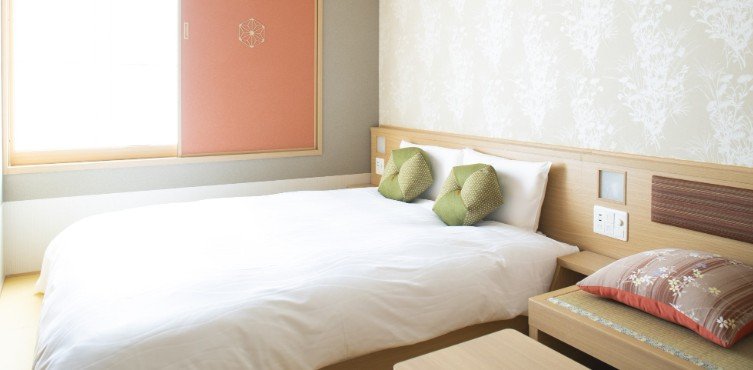
Very importantly, that pink window panel can be slid over to plunge the room into total darkness and block sound.
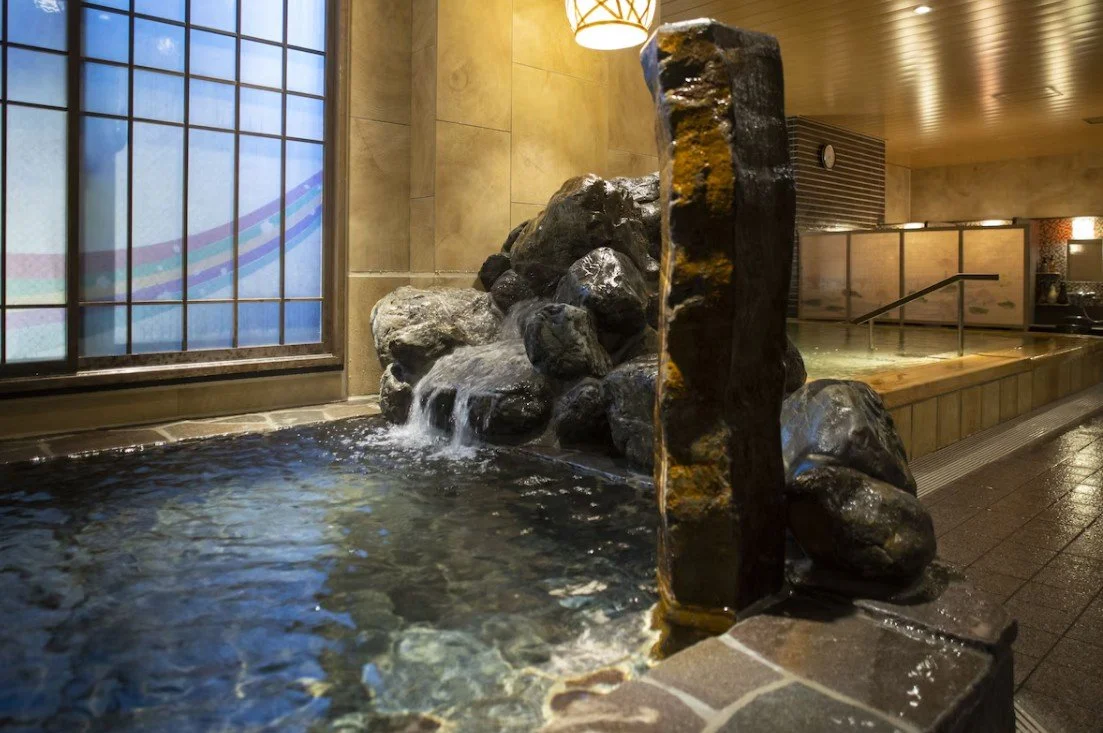
Shamelessly stolen photos of things I couldn’t take pictures of.
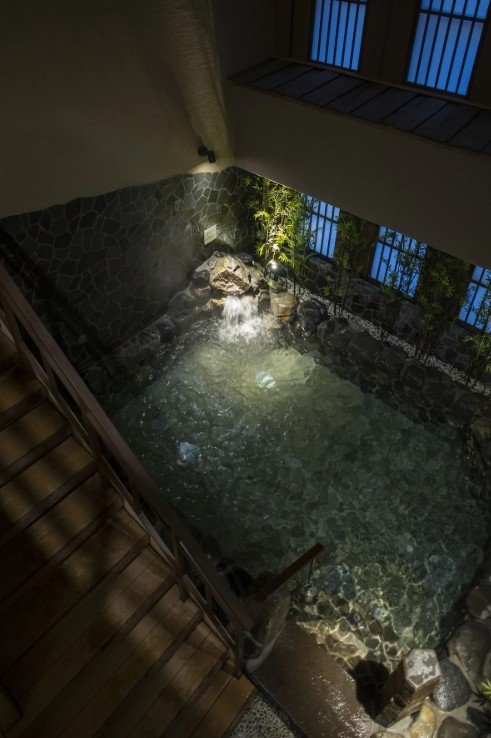
This hot spring was in a two-story atrium. The stairs led up to another level of baths.
Kimono Rental
After dumping our luggage and taking a quick shower, we hurried off to an appointment I’d long been looking forward to—a kimono rental and traditional tea ceremony in Kyoto’s historic Gion district. It’s kind of a fantastic setup; the staff there are experts at dressing visitors and can get you fully kitted out in a kimono (with your hair styled!) in like 20 minutes flat. You can even hang out in the city in your kimono for the rest of the day, as long as you return before they close. Anyway, after getting fitted and dressed in my size 4XL kimono (which I tried not to take personally), Jeff and I were ready to meet, take some photos, and explore the gardens before our tea ceremony.
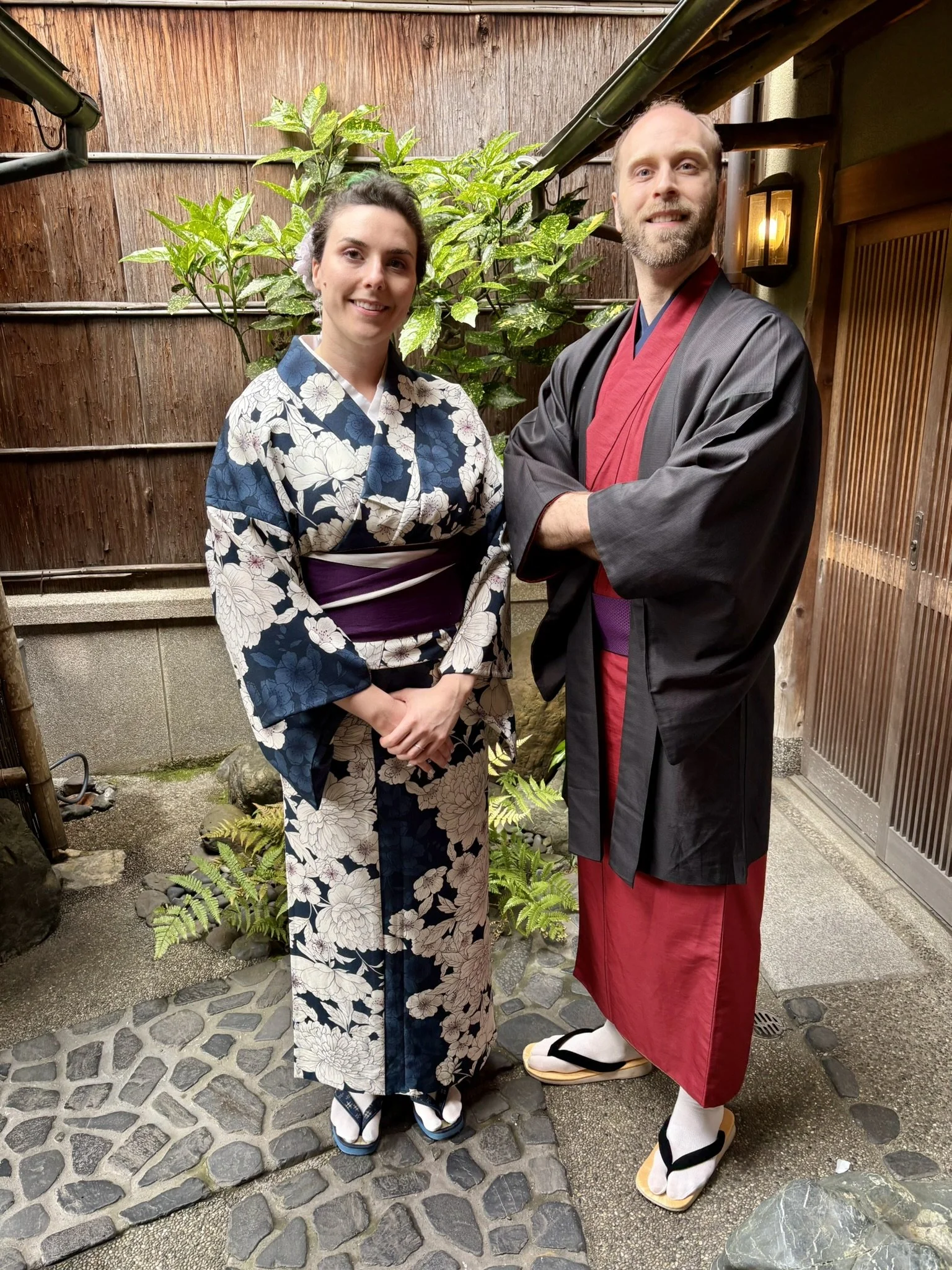
We’re both bad at taking pictures, but we gave it our best shot.
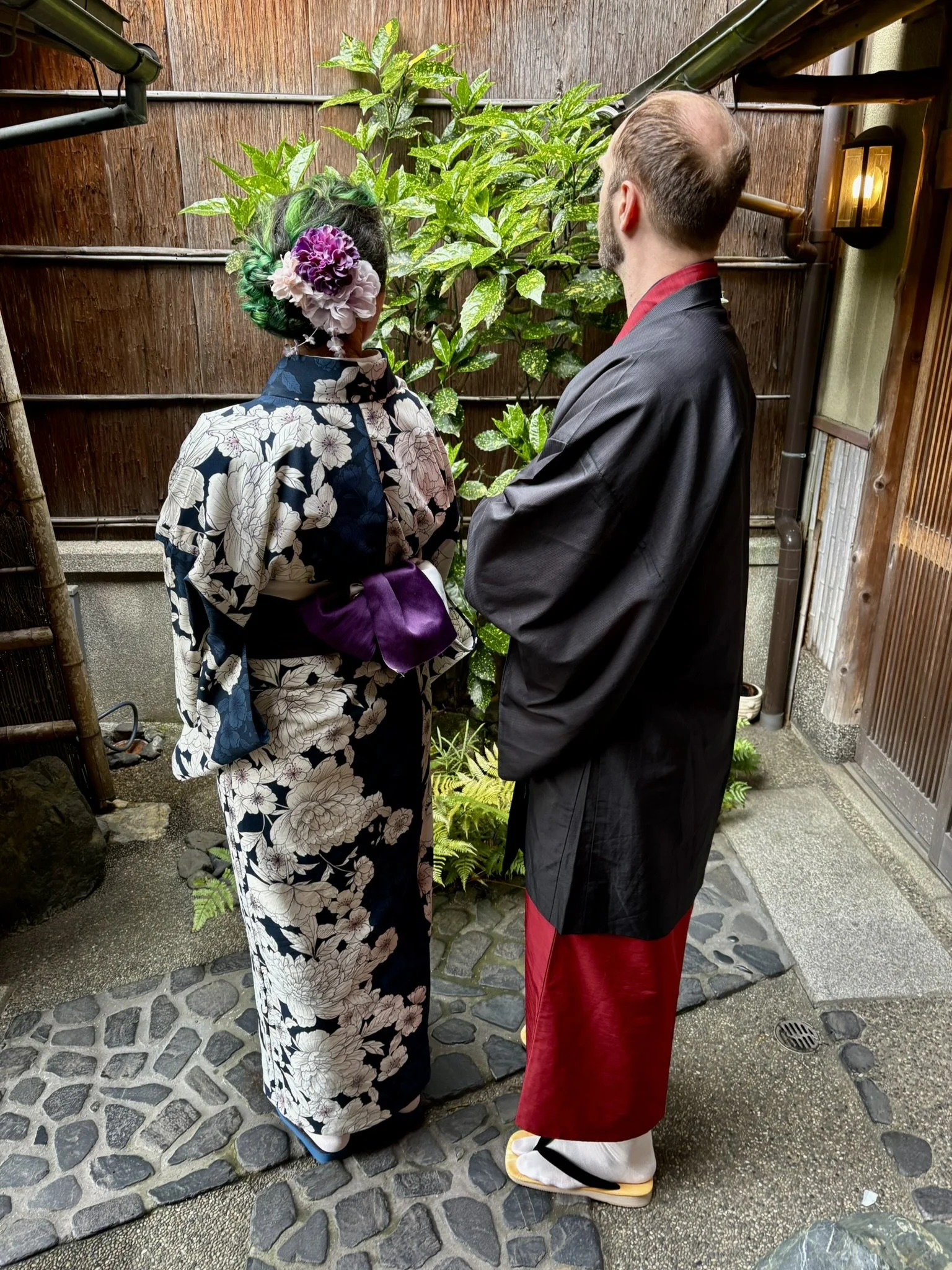
At all angles, even.
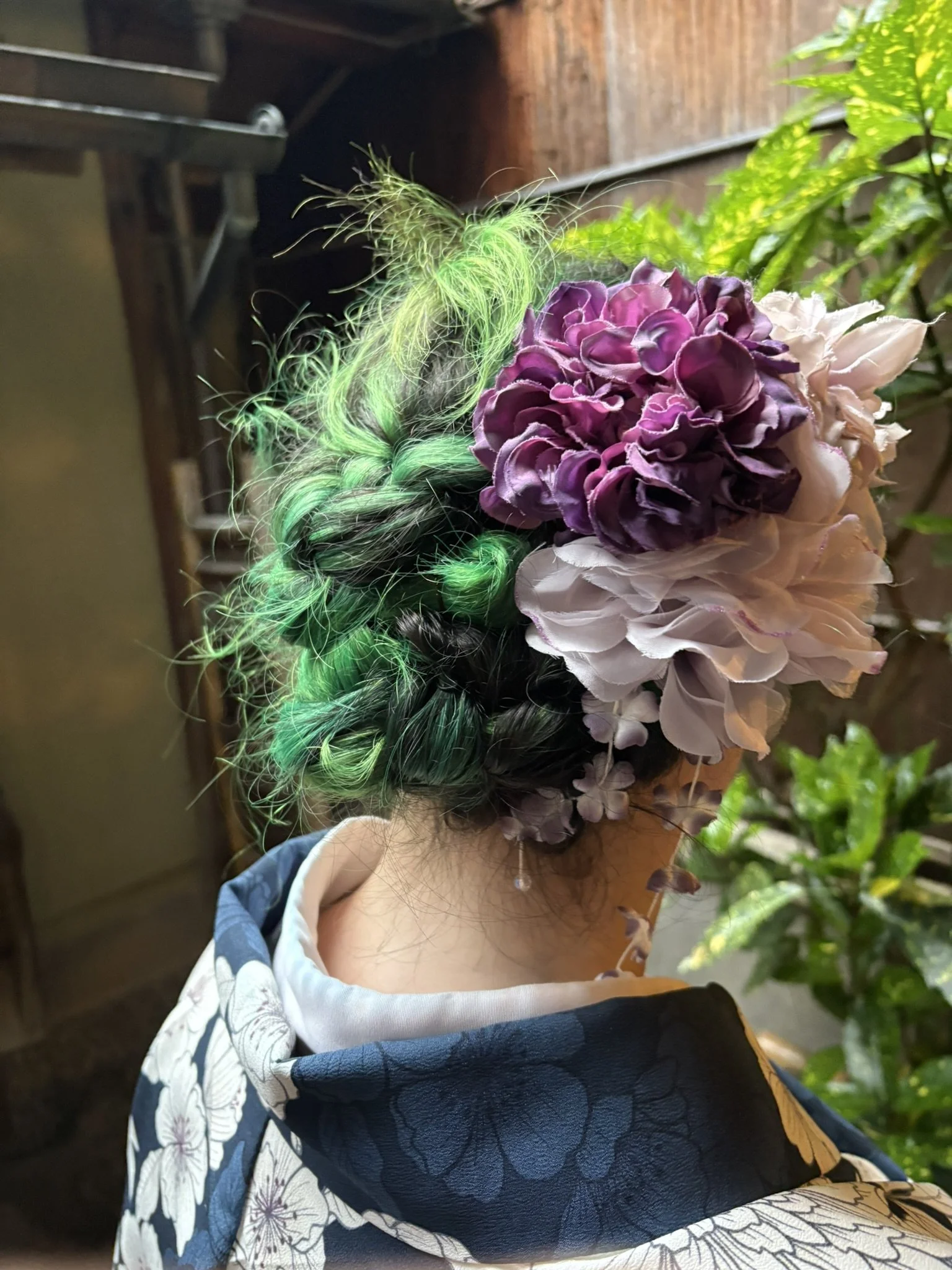
I got so many compliments on my hair :) (even though the humidity was doing a NUMBER on me).
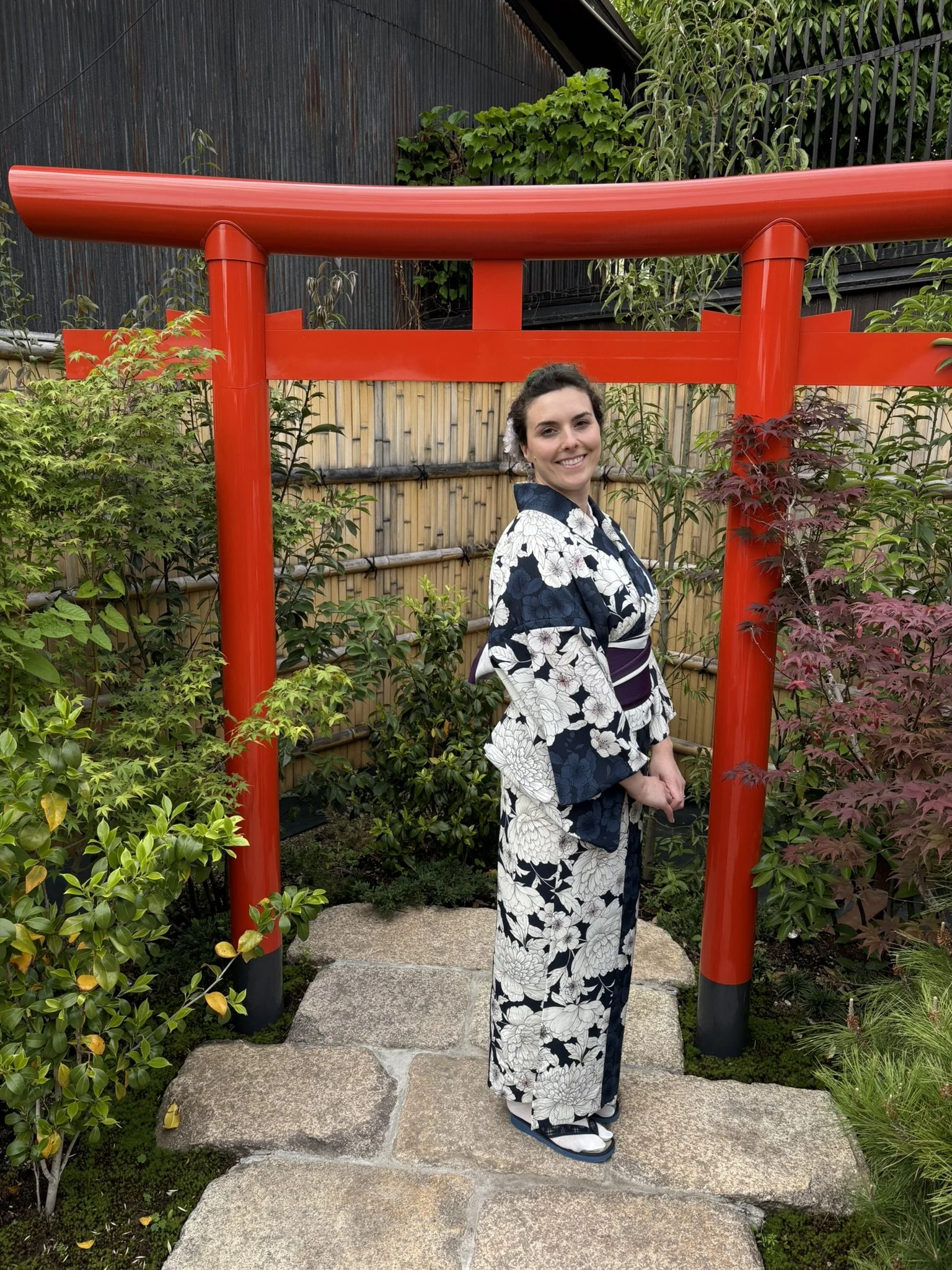
Leaving room for spirits. Just to be polite.
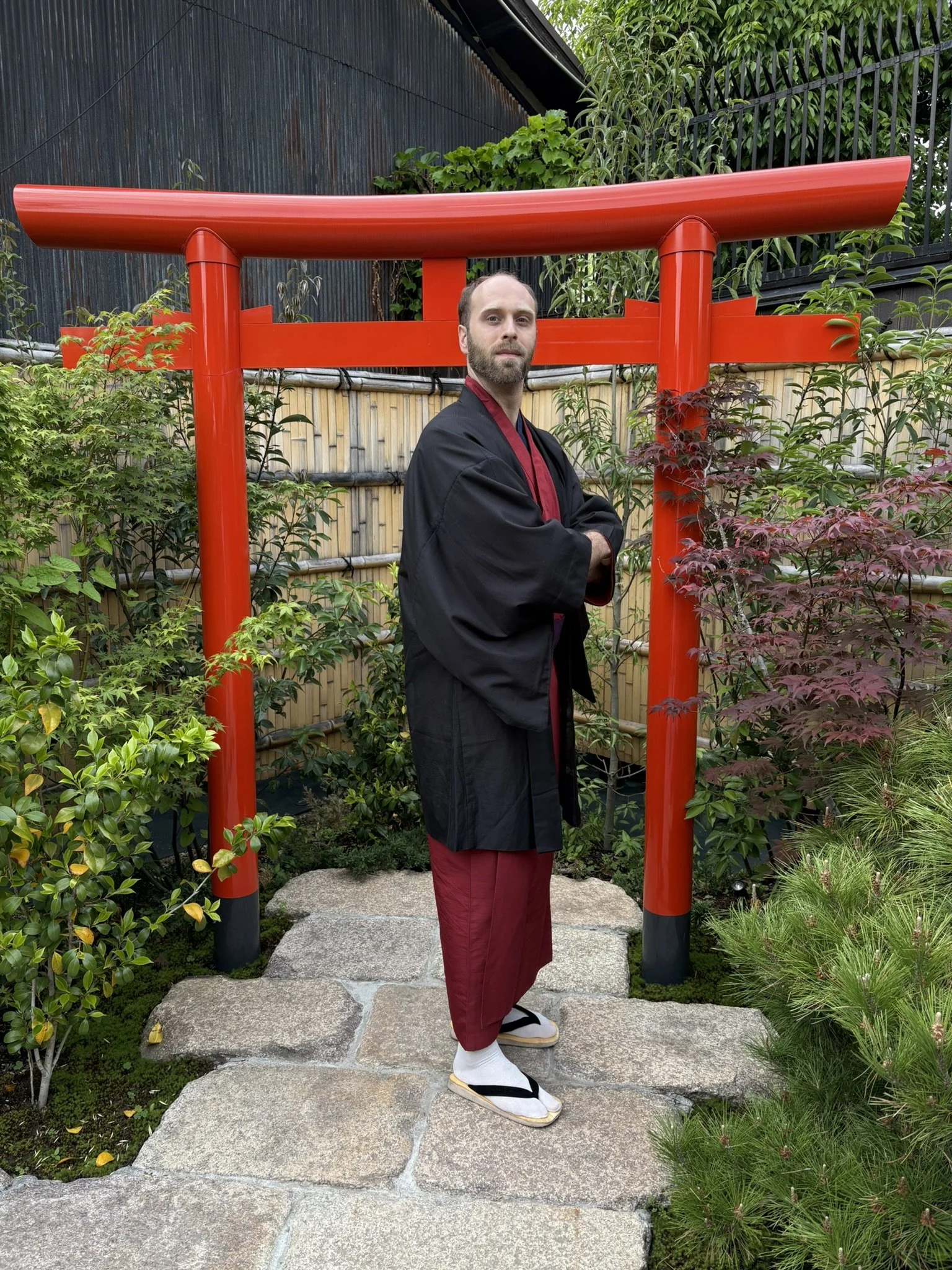
My only regret is that we didn’t goof around and do a bunch of prom poses.
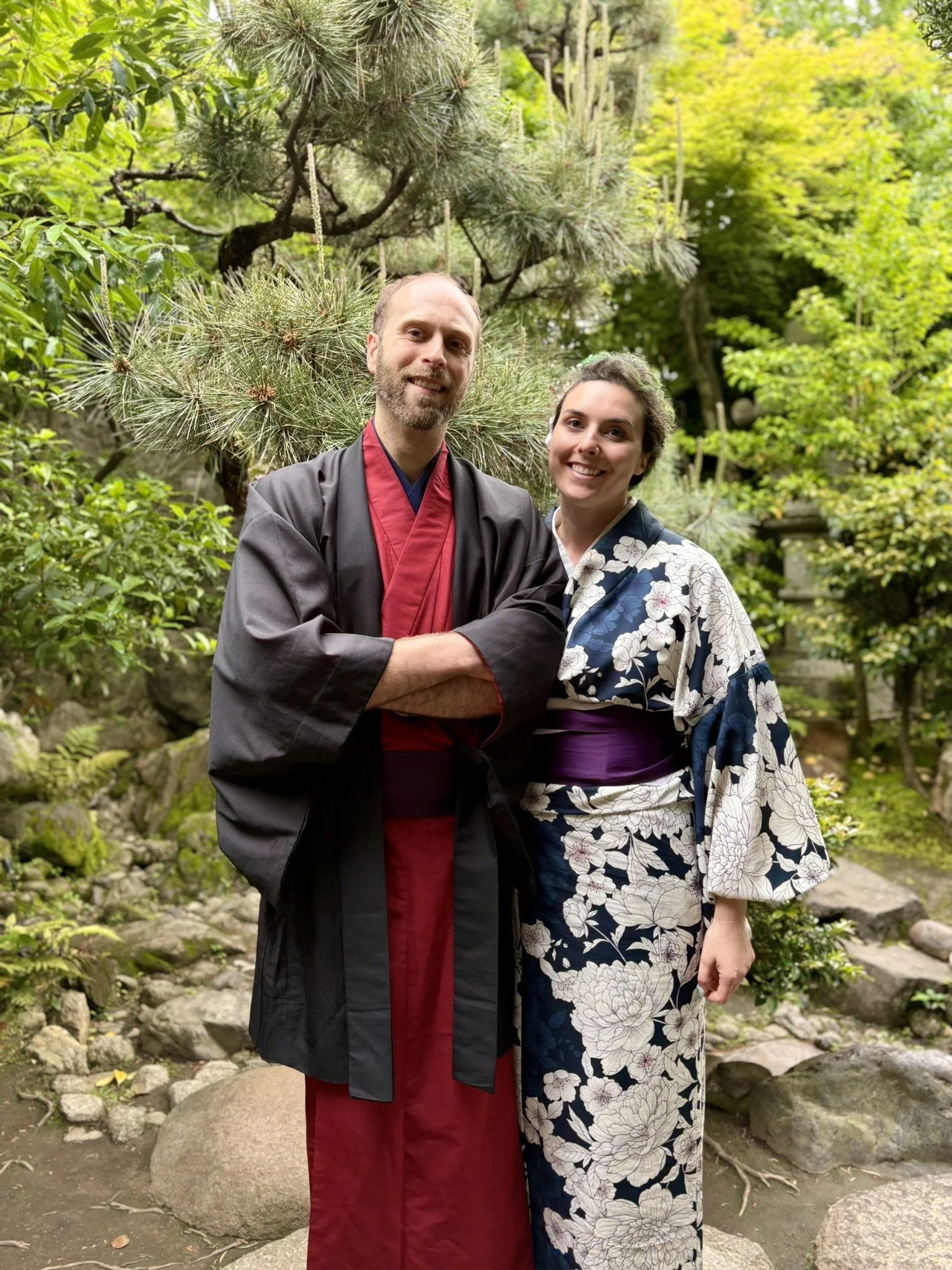
In the gardens outside the tea house.
The Tea Ceremony
A full, formal tea ceremony is a multi-hour event served with a meal and is the ultimate show of hospitality towards one’s guests. We experienced an abbreviated version of this ceremony, which included an opportunity to learn how to prepare matcha (a drink made from powdered, specially prepared tea leaves). The Kyoto region is considered the origin of matcha and the place to get the highest quality.
Before we began our ceremony, our hostess, Jun, explained how a tea ceremony is performed and walked us through the spiritual and cultural symbolism practiced with each step, including the concept ichi-go ichi-e (“one time, one meeting”), which reminds people to treasure each gathering they take part in. No moment in time can be repeated, even when the same people are together, which makes each gathering a once-in-a-lifetime occasion.
Hilariously, as we continued chatting, we ended up finding out she’d had a roommate from Michigan State University in her first year of college. Ichi-go ichi-e, indeed.
Jun told us we could take pictures as she began, but honestly, it felt like it would be a bit disrespectful. She’d mentioned she’d trained for two years to learn to serve tea to guests, so we chose to treasure the moment and observe while sitting in seiza (the traditional/formal style of sitting).
After beginning the ceremony, Jun poured us hot water and showed us how to make up a cup of matcha tea with a bamboo whisk. The technique is tricky, but she was a good teacher, and both of us ended up with tasty, frothy matcha to drink.
I was glad I booked a private ceremony for the two of us. It was more costly, but it was worth it for the opportunity to really get a lot of one-on-one time with a hostess and ask tons of questions about her work and tea traditions!
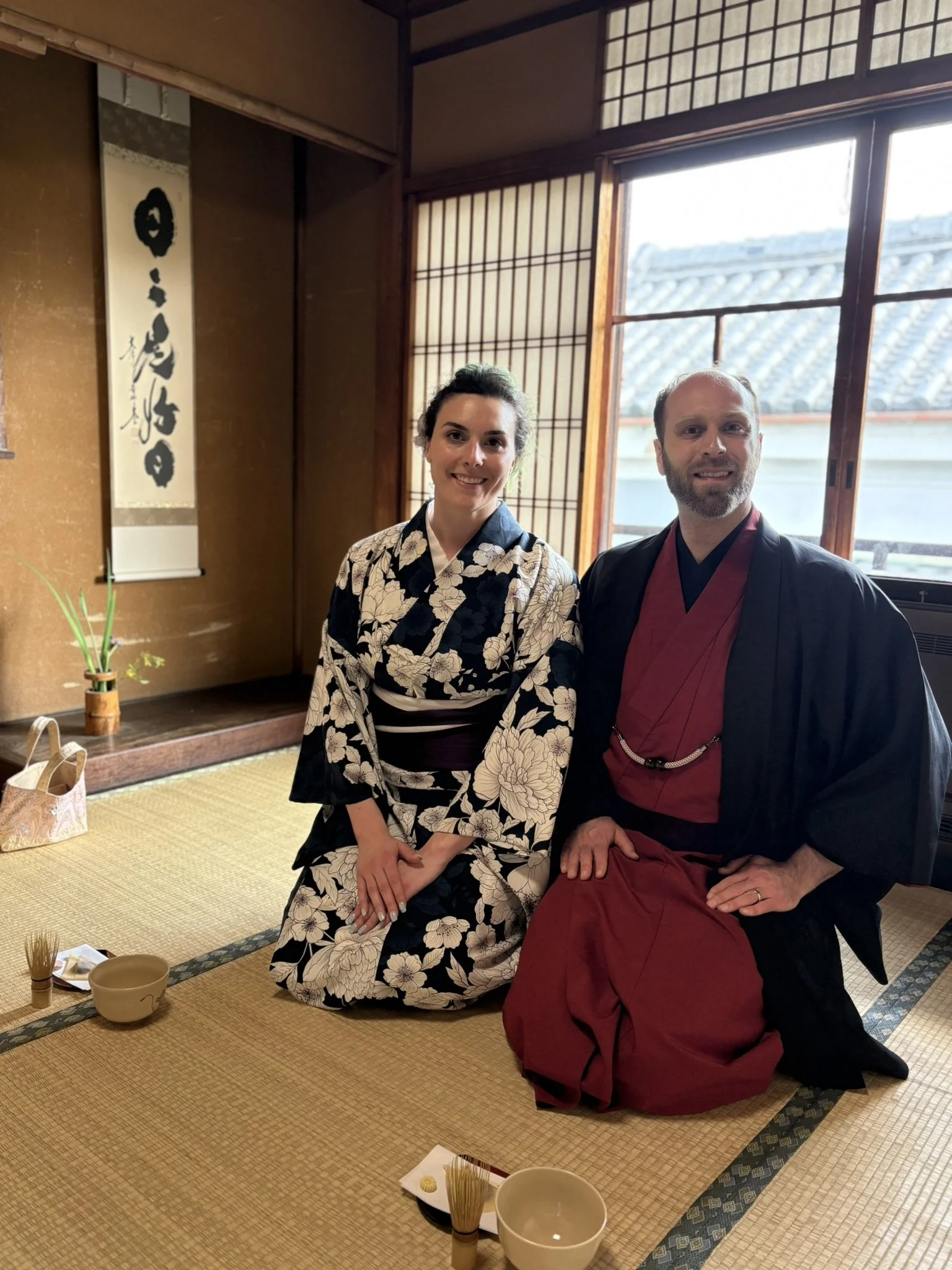
Sitting in seiza. Kimonos are meant for cooler temperatures, not summer weather, so we were a bit dewy by the time we got to our ceremony.
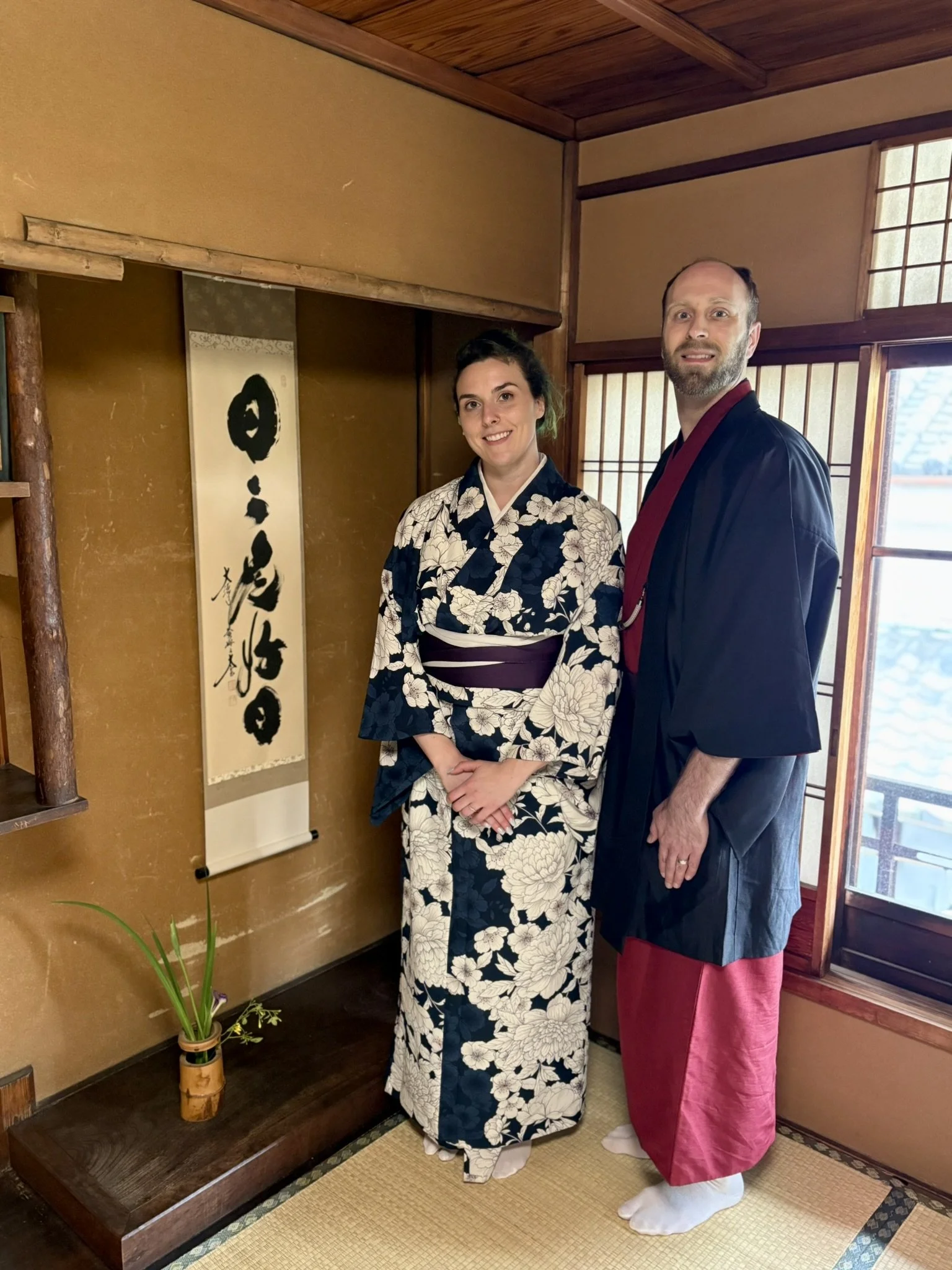
Hanging scrolls play a central role in the ceremony. They are selected for the occasion and will be displayed with other seasonal decoration.
After our ceremony, we chilled in Gyon for a bit and enjoyed some Matcha sweets at a tea shop, which is where I experienced one of many comedic out-of-body experiences in Japan.
We thought we were having a cute little time together, enjoying some matcha fondue and soaking in our cultural experience, when Chicken Fried by Zac Brown Band came on over the speakers. First I thought I was hallucinating from the heat. Then we were like, “Do you think they put this on because we’re here?”
Then, after taking back our kimonos and grabbing some tasty tempura for dinner, we were ready for our evening plans.
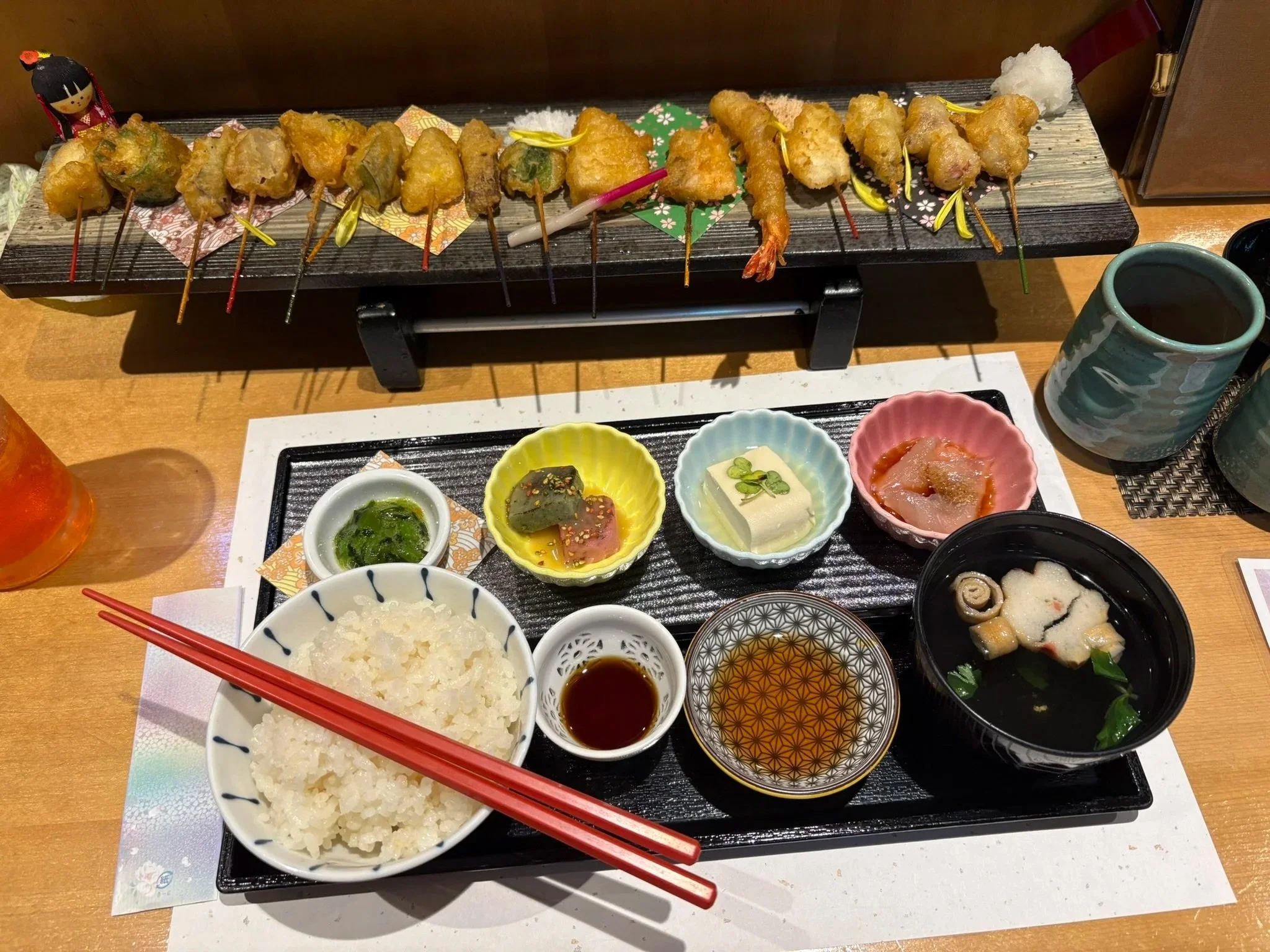
If you’re a person who can’t get just one flavor of ice cream, you’ll love dining in Japan. It’s all about trying a little bit of everything.
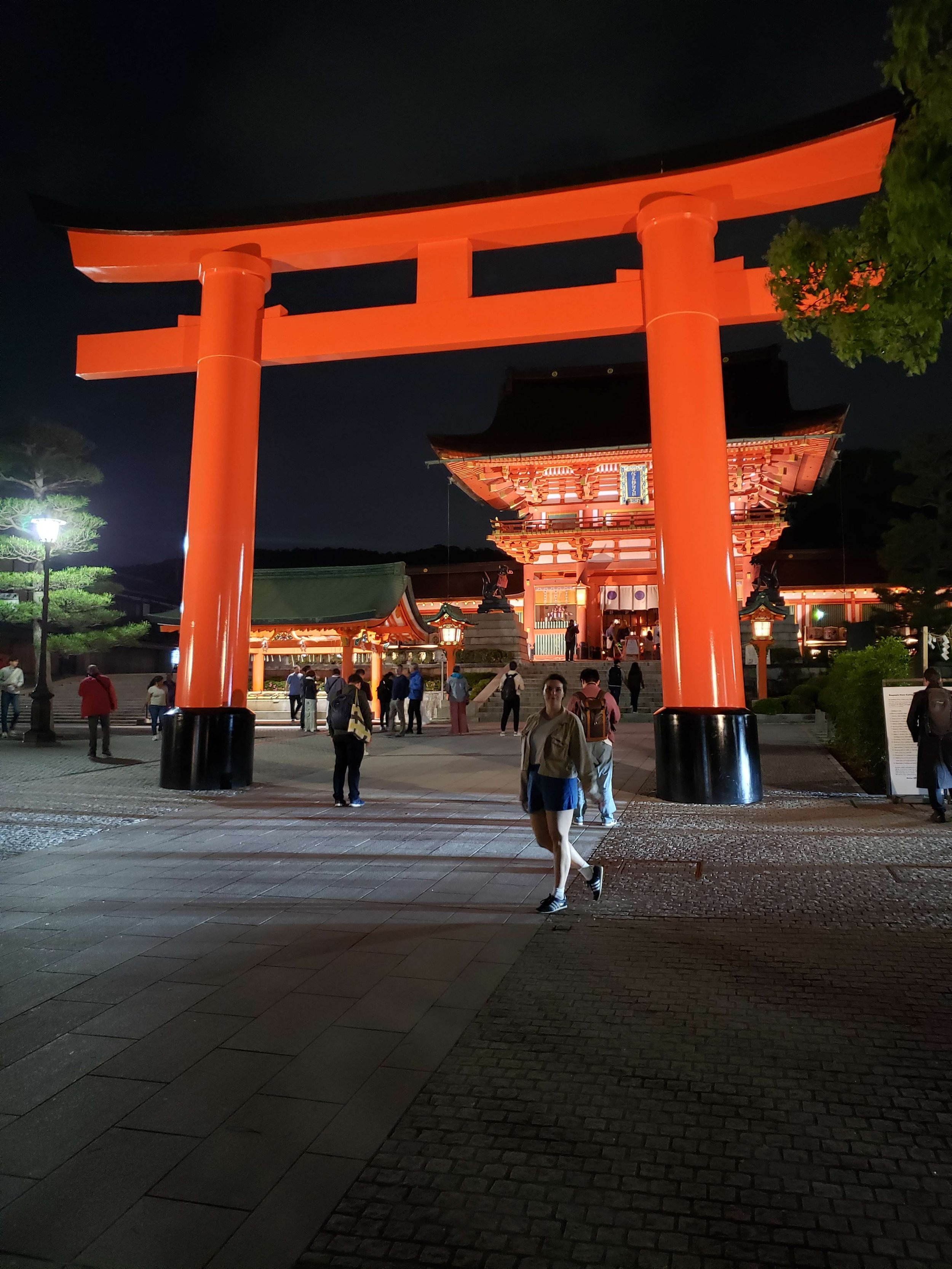
Pro Traveler Tip #6: If you can’t beat the crowds in the morning, you can always try at night.
Fushimi Inari Taisha
You might be thinking, “Wow, what a packed day!”
Well, it wasn’t over yet. Fushimi Inari Taisha is an iconic Shinto shrine in the Kyoto area, famous for the thousands of torii gates marking the trails and walkways. And, unlike many shrines, it’s open for visitors 24/7 (part of this is because the walkways and trails run all the way up the 750ft peak of Mount Inari, and good luck fencing all of that off, I guess). I’d read it gets pretty crowded during the day, so I thought we’d try our luck with a nice hike at night.
Fushimi Inari is dedicated to Inari, the Shinto god of rice. For obvious reasons, she’s pretty important to the Japanese, and one third of shrines are dedicated to her. One thing I didn’t realize until we visited is that many of the gates here are actually donated by companies, and the donor’s name and donation date are inscribed on each of the gates. They’re not cheap, starting at 400,000 yen for a smaller gate (~$2700) and over one million for a big one ($6800).
The hike took about 2 1/2 hours and was the perfect way to spend an evening. Based on how the weather was in Kyoto the rest of the time, we probably would’ve sweat and died horribly doing it in the daytime.
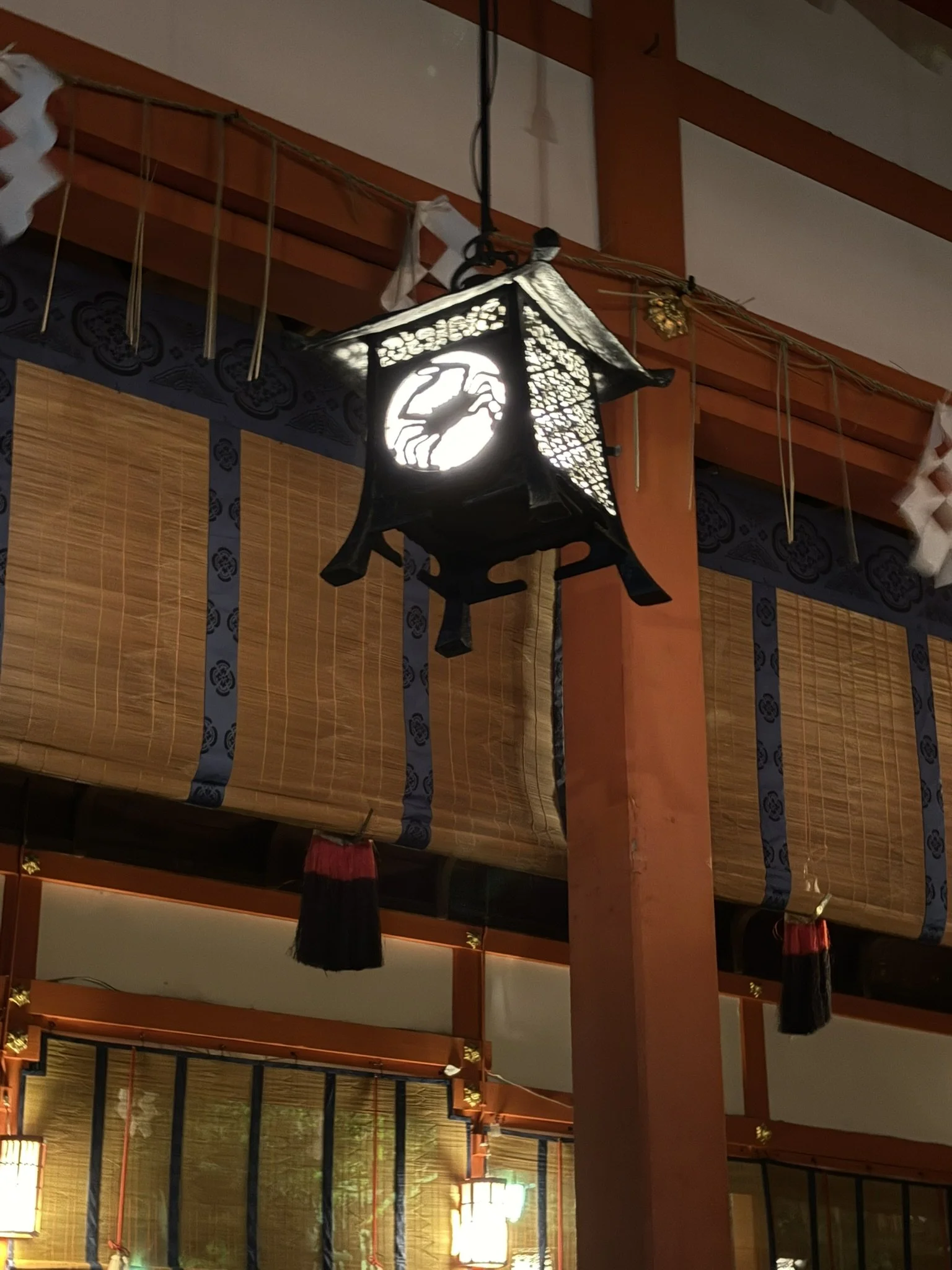
What does this crab lamp signify? A closed food stand, I think—but everything looks cooler at night.
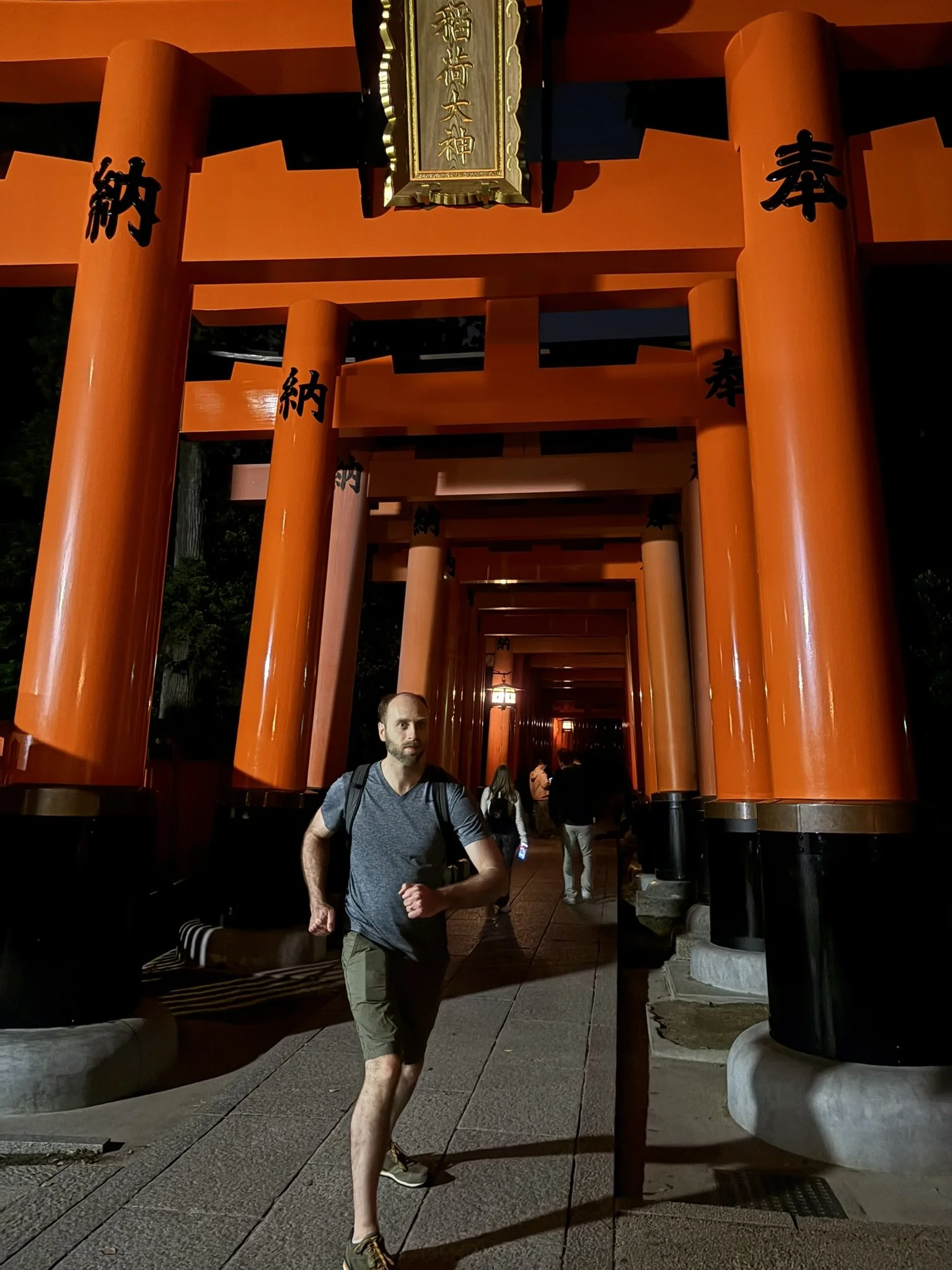
Ready to hike.
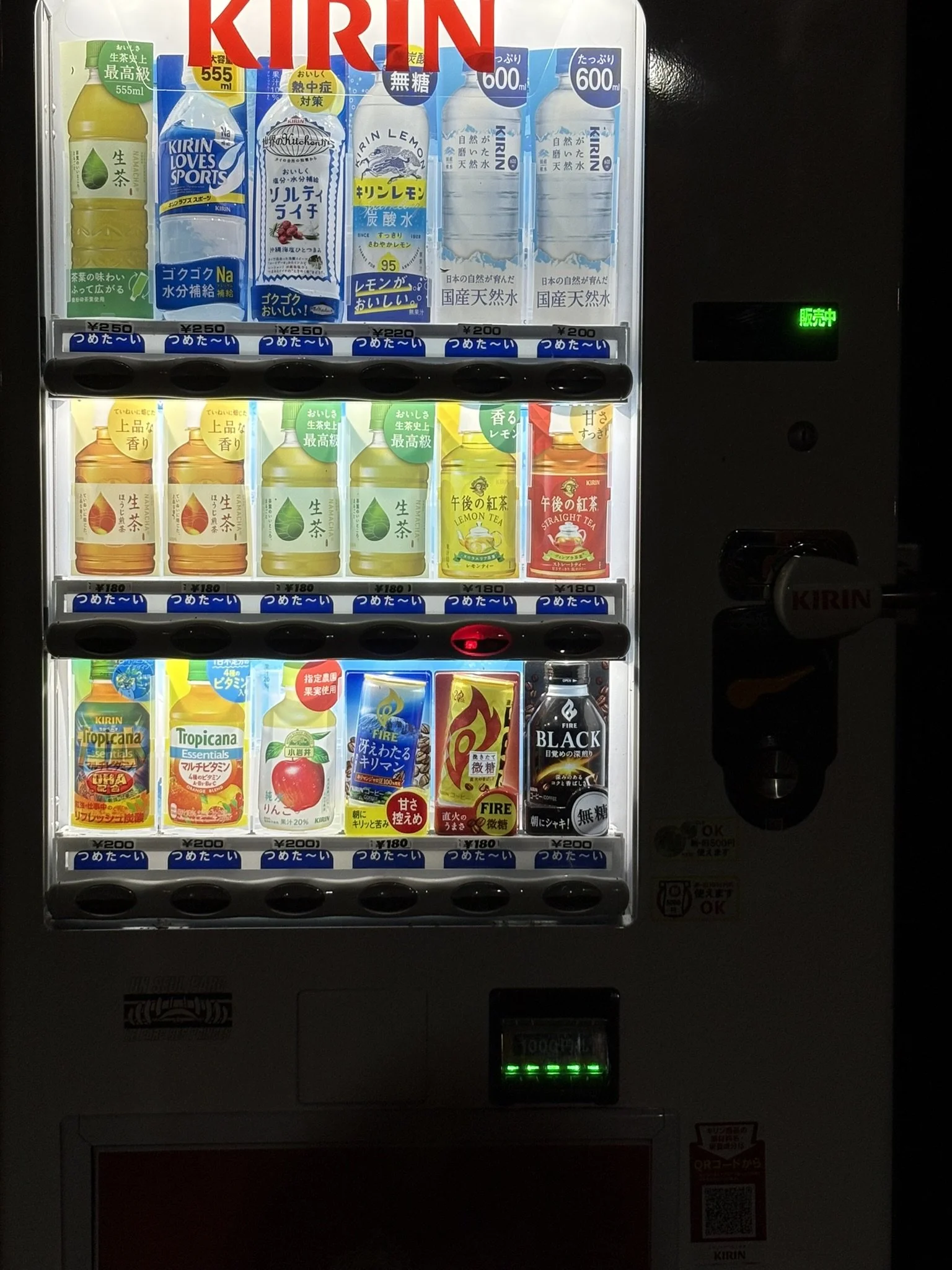
We stopped seeing vending machines with English labels about 1/3 of the way up to the summit. I love Japan, honestly.
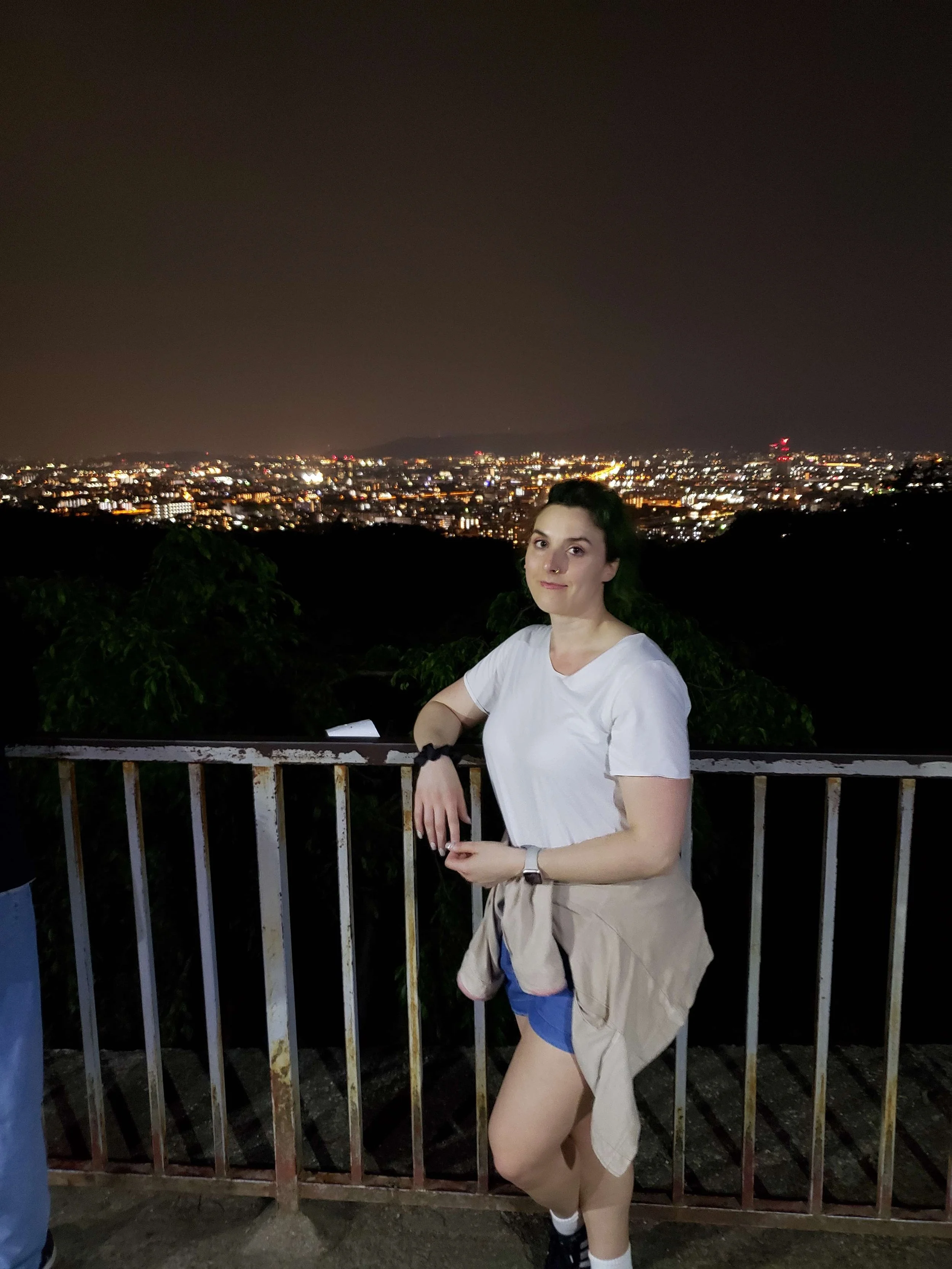
About halfway up the mountain, you’ll arrive at the Yotsutsuji intersection and be rewarded with some fantastic panoramic views of the city.
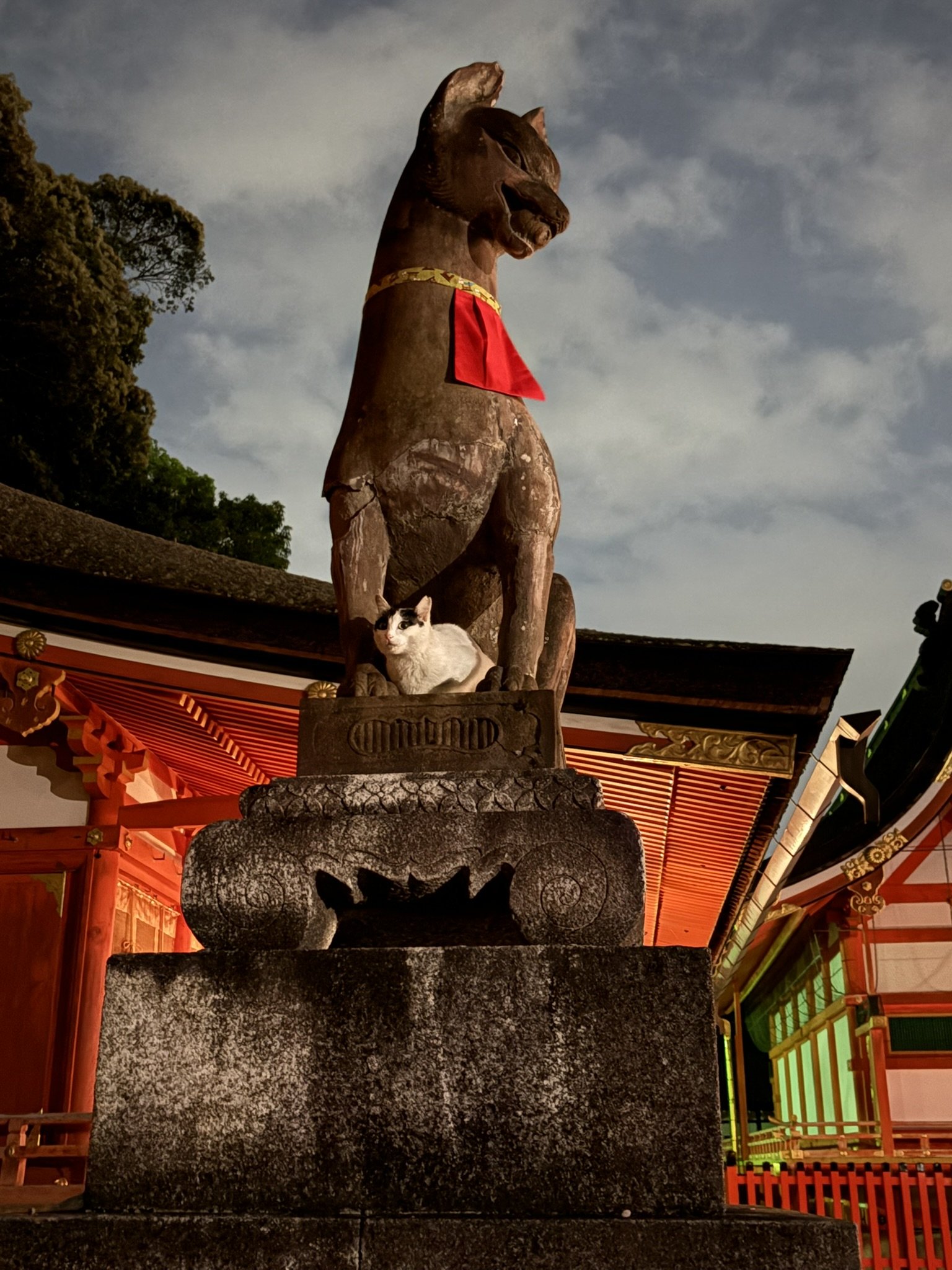
The sacred grounds feature many statues of foxes—Inari’s spiritual messengers—but this cat seemed to think she was just as important.
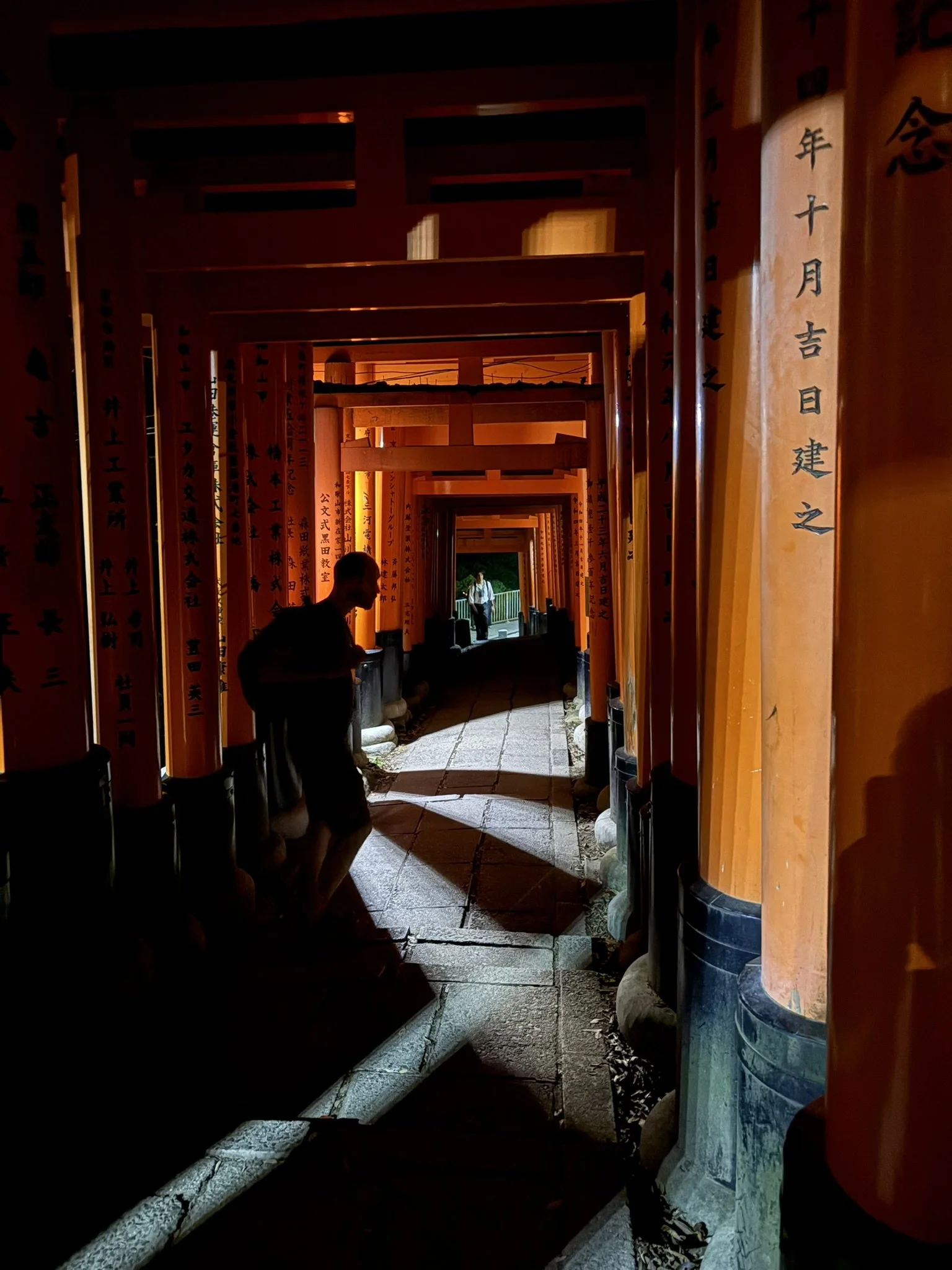
The paths are SO awesome at night—the light intersects through the gates and makes all these cool little patterns on the ground.
The Summit
The Yotsutsuji Intersection is a place about halfway up the mountain where the trail splits into a circular route to the summit. There were only a handful of people by this point, but plenty of signs warning us about monkeys and wild boars. We actually did see boars, but they were babies, and they were suuuuuuuper cute. The Japanese actually call them uribou, or “melon boys,” because of their stripes. They really do look like little melons!! Luckily, we didn’t see any adults.
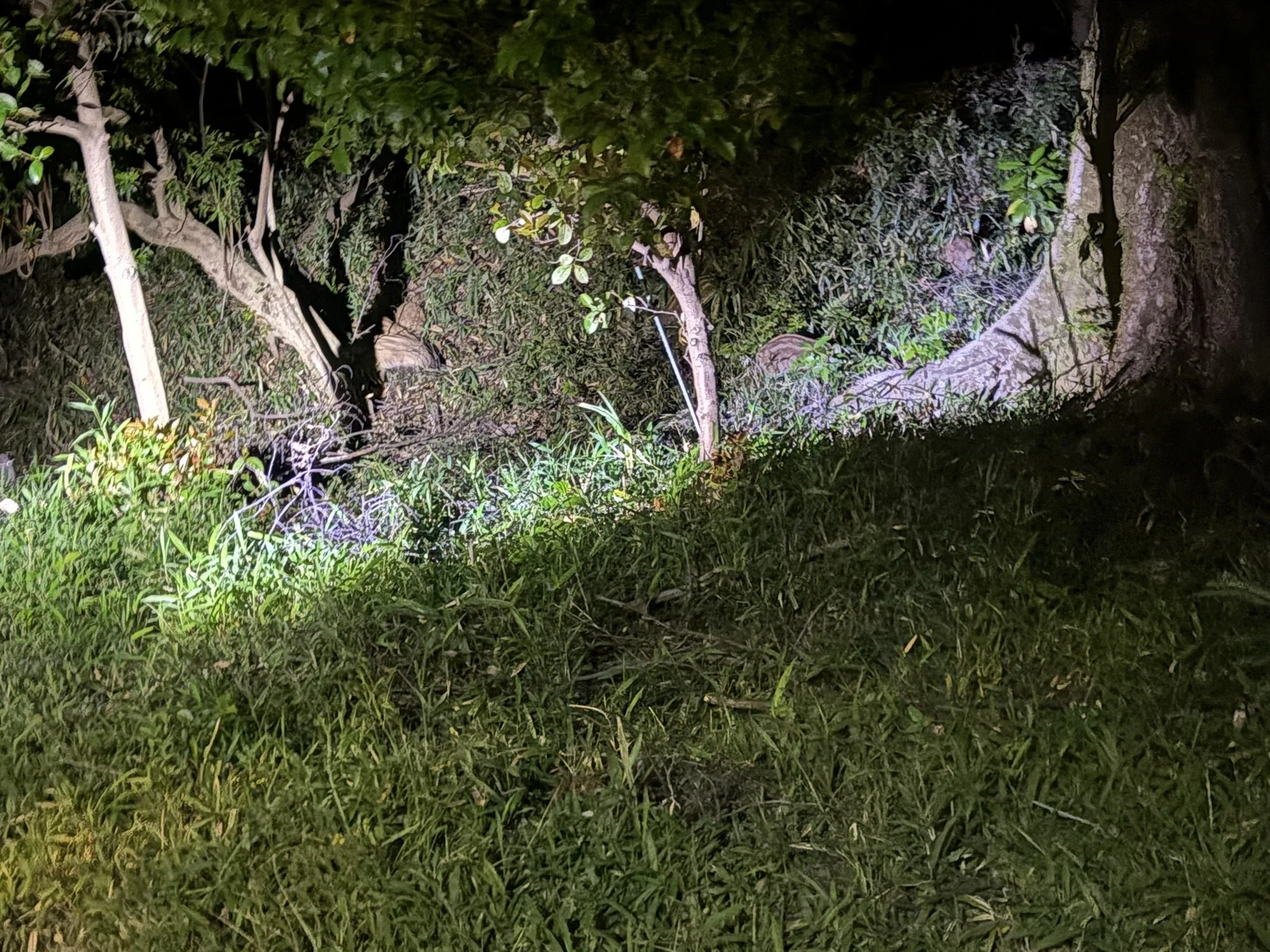
Buddies!!!

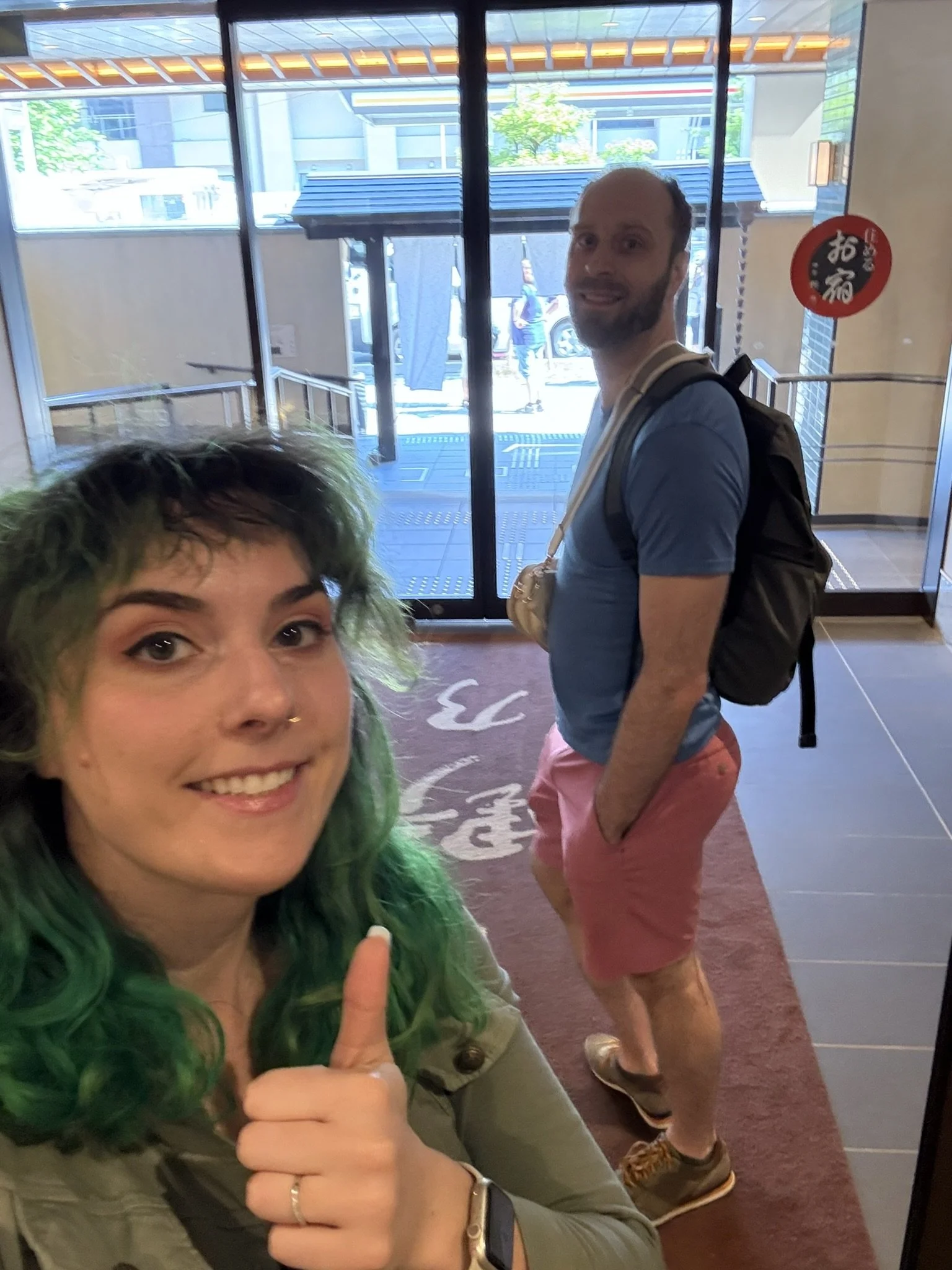
Bright-eyed, bushy-tailed, and pretending that our feet don’t hurt after yesterday.
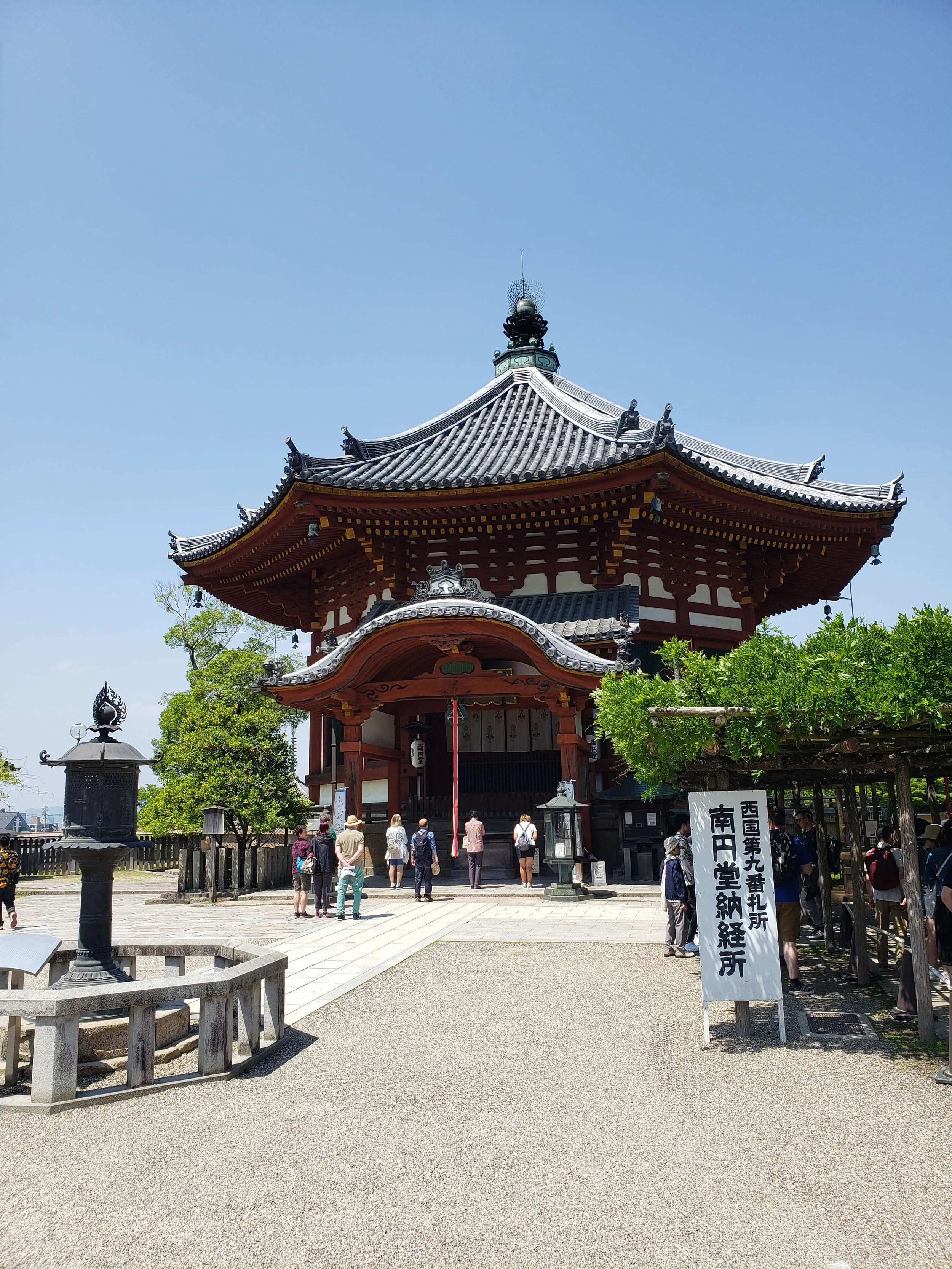
The buildings in this area are on the grounds of Nara’s former imperial palace. The capital moved from Nara to Kyoto in 794.
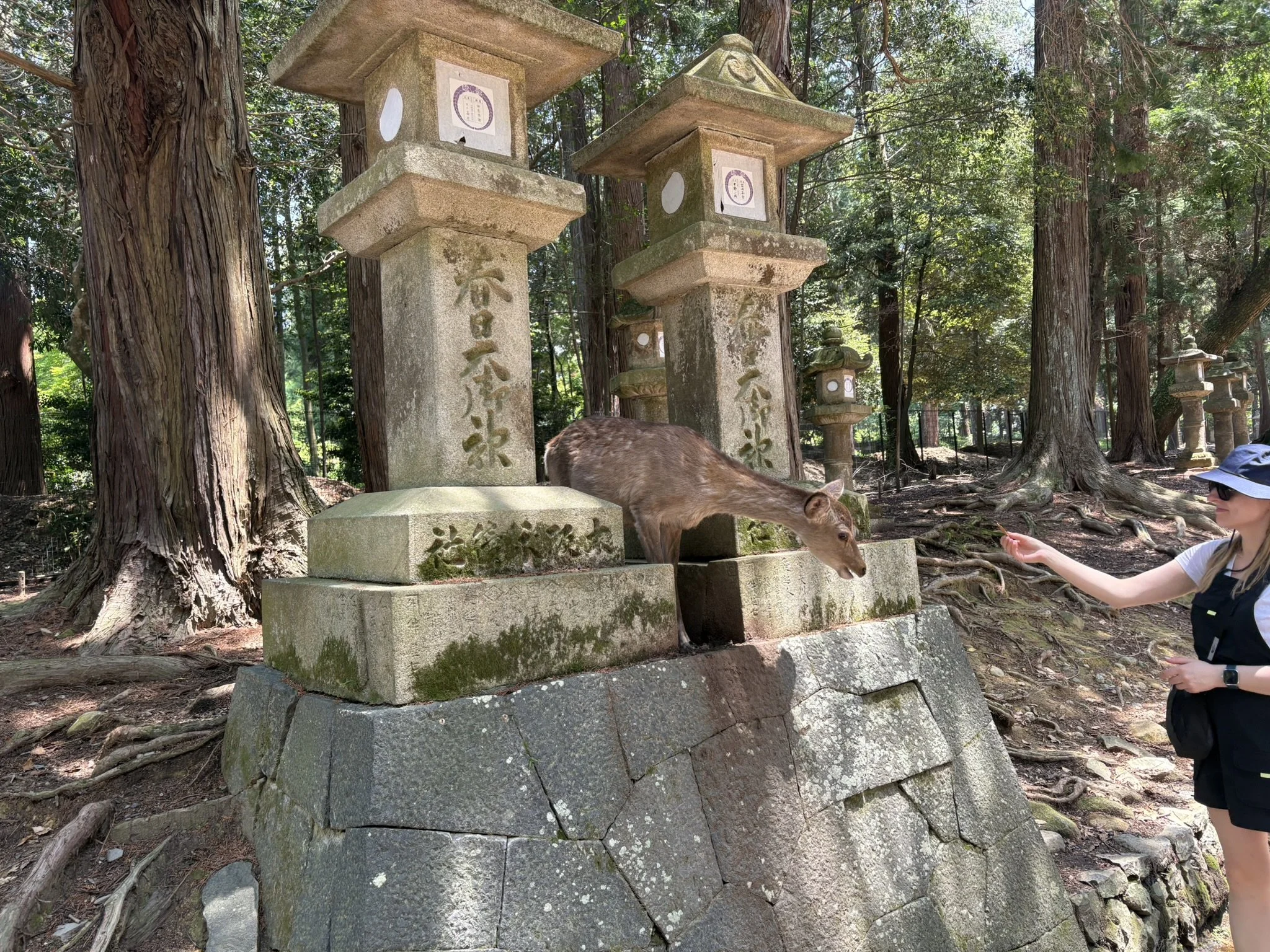
“Look at me! And feed me!”
Day 5: Day Trip to Nara
May 13
Steps walked: 24,561
Flights of stairs climbed: 16
Our second day in Kyoto, we headed to the station for a little day trip to Nara. Nara was actually Japan’s first capital city, but today, it’s most famous for its temple (Todai-ji) and its park full of tame deer.
I actually opted to do a guided tour for this city, and it was great being able to get some context for some of the things we’d seen in other shrines and temples.
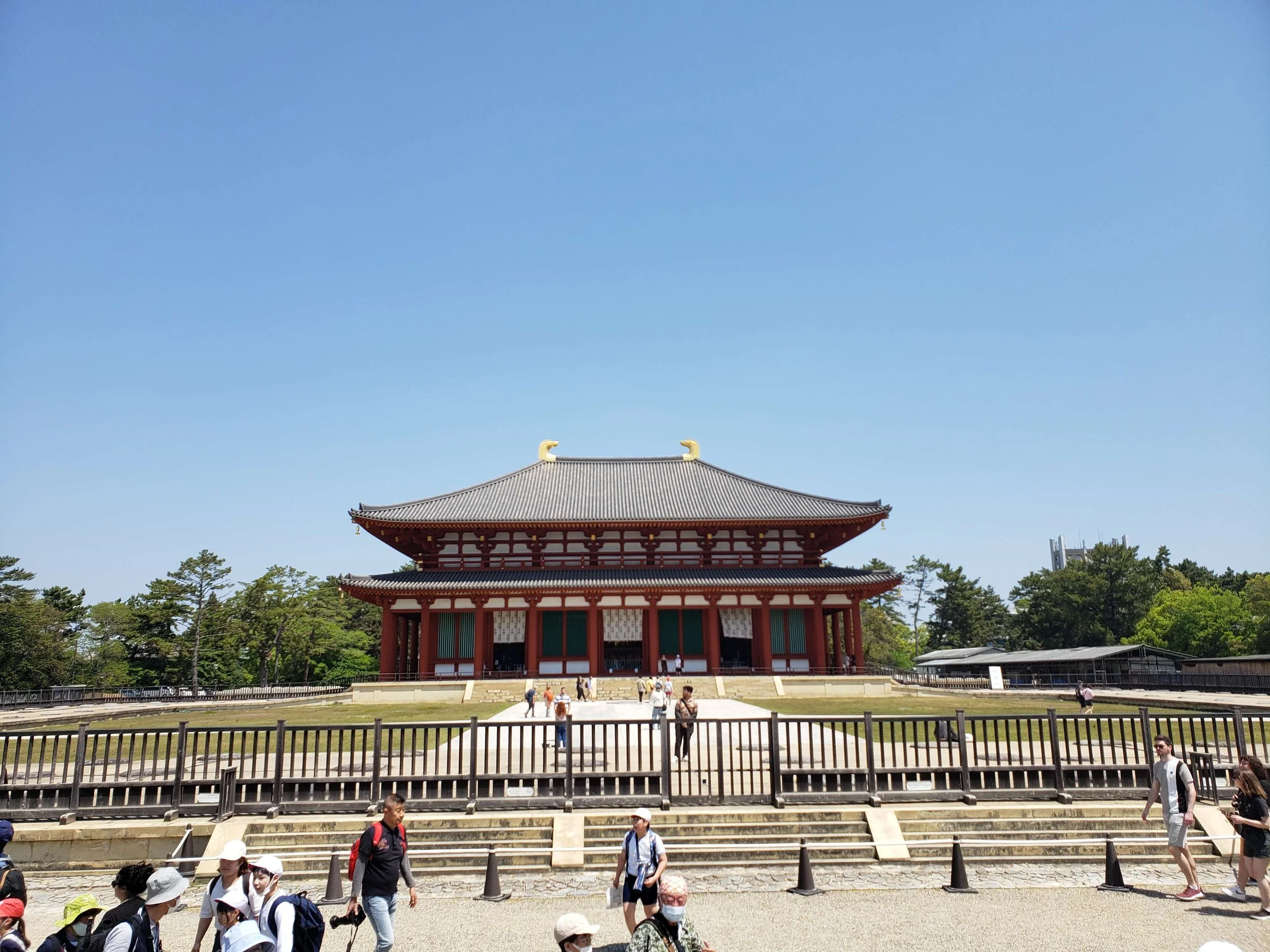
Our guide explained the golden ‘horns’ on a lot of buildings in Japan are actually fish tails, and they’re said to help prevent fires. Naturally, this building burned down like twice, and the fences are up because it’s still being reconstructed.
Nara Park
Being born and raised in Michigan, it was a VERY odd experience for me to see and interact with the Sika deer in Japan. They’re only semi-wild—not domesticated, but fully used to the presence of people.
In other places they’re kind of considered pests, but the deer in Nara are sacred, believed to be messengers for the gods of Kasuga Taisha Shrine. They have been protected by the locals for over a thousand years—it’s illegal to harm them, and our guide told us they actually hold little ceremonies to mourn the deer that die after getting hit by cars.
The deer in Nara have learned to bow to ask for food. It’s exactly as cute as you’d think. We did learn from our guide that best practice is to buy crackers from the vendor carts and then book it elsewhere, because the deer that hang out by the carts go there specifically because they’re hangry buddies, and they can get a bit pushy.
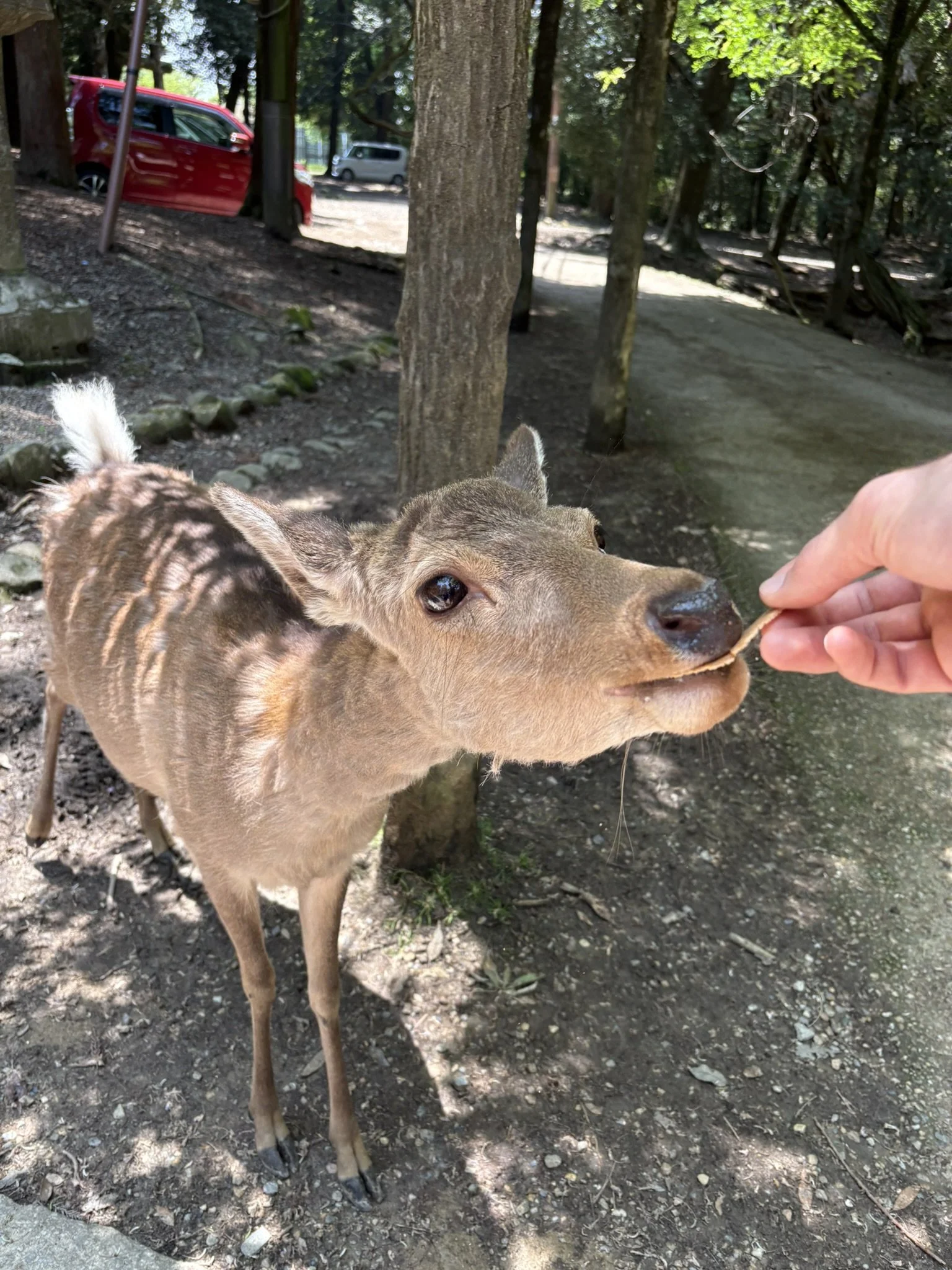
The park has a few vendors that sell barley crackers for the deer. You can’t feed them just anything!
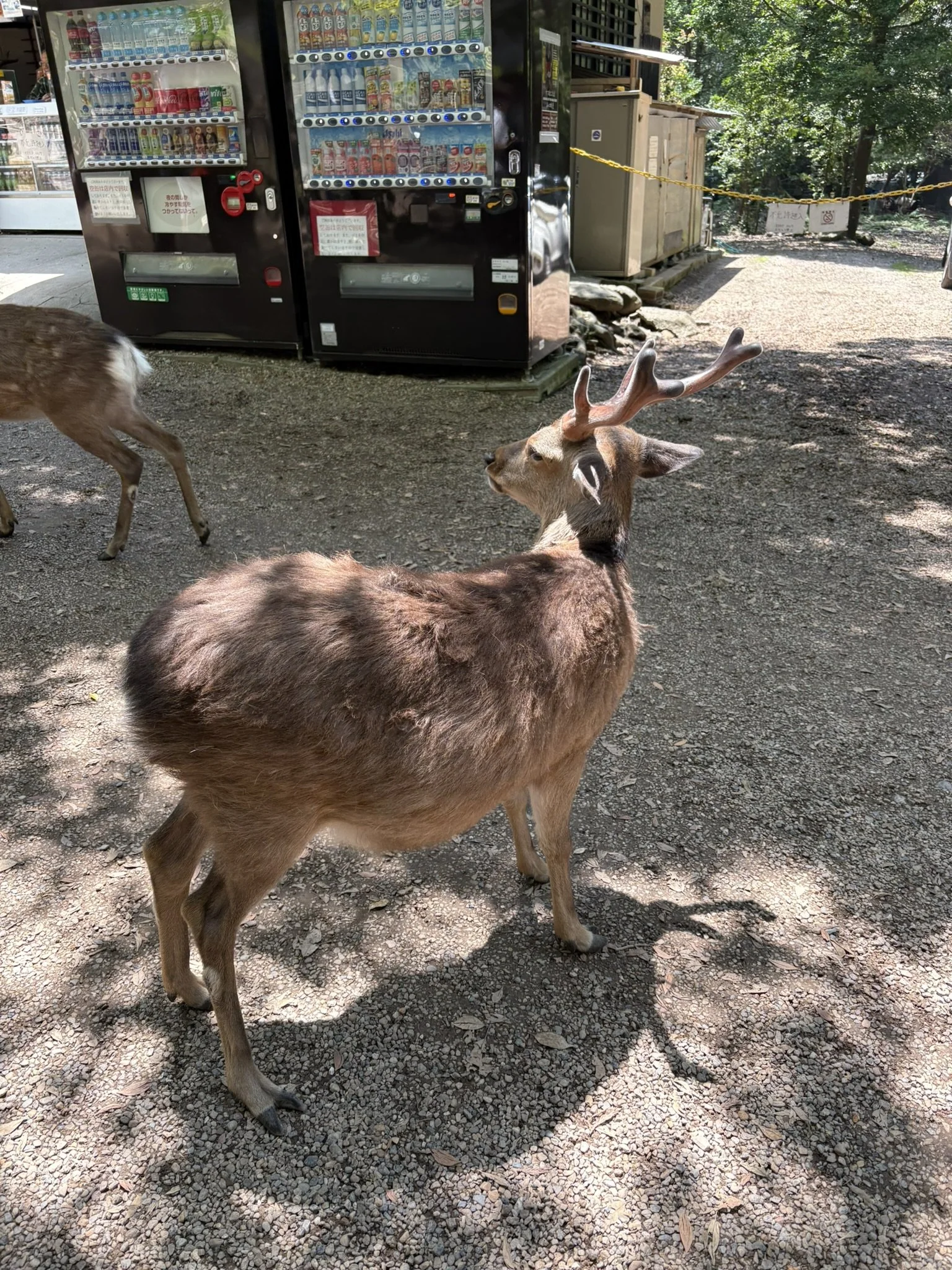
The deer with antlers are really the ones you need to watch out for.
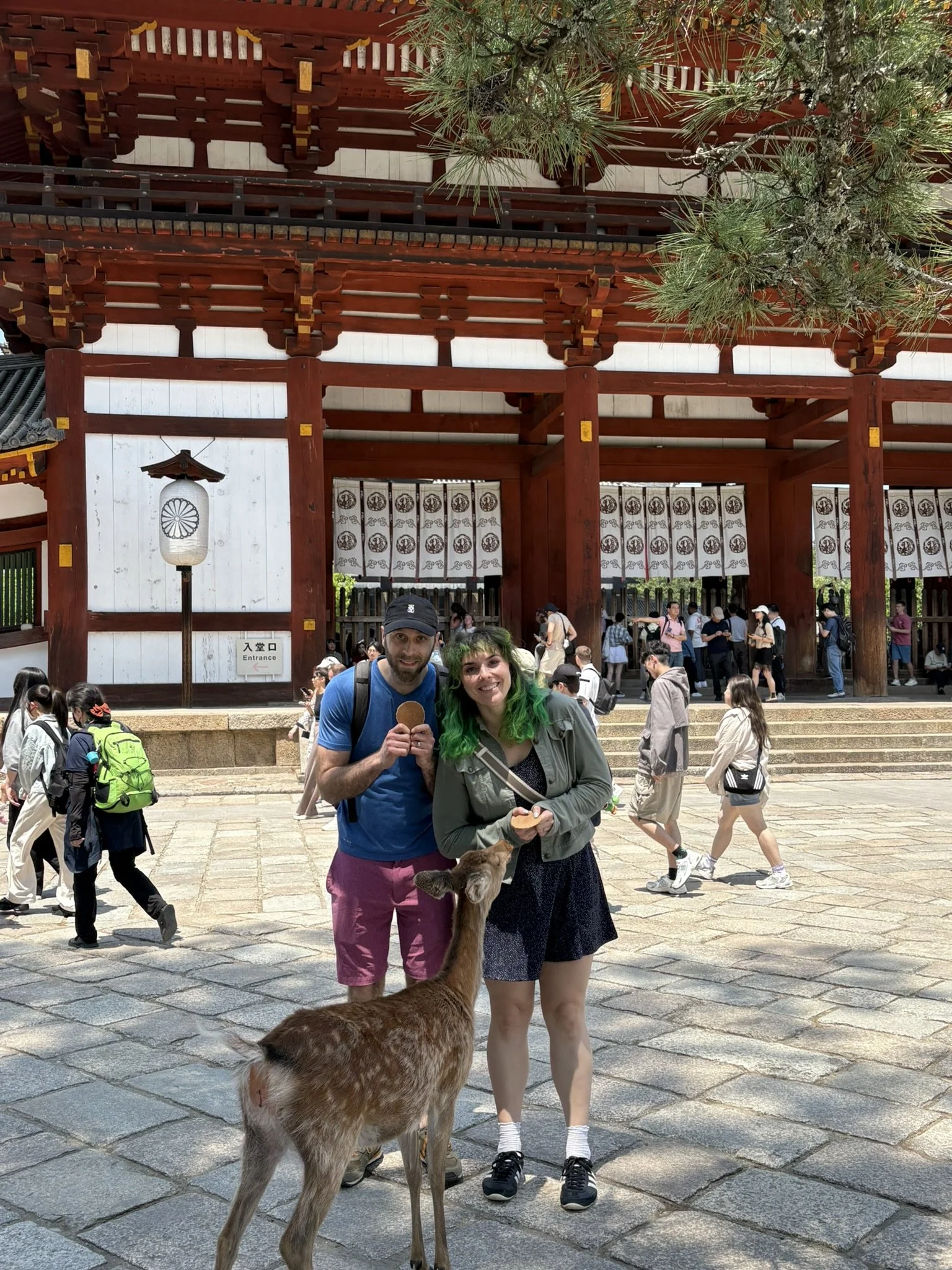
Imagine trying to get a photo in front of a historical site and just being accosted by deer the entire time. That’s Nara, baby.
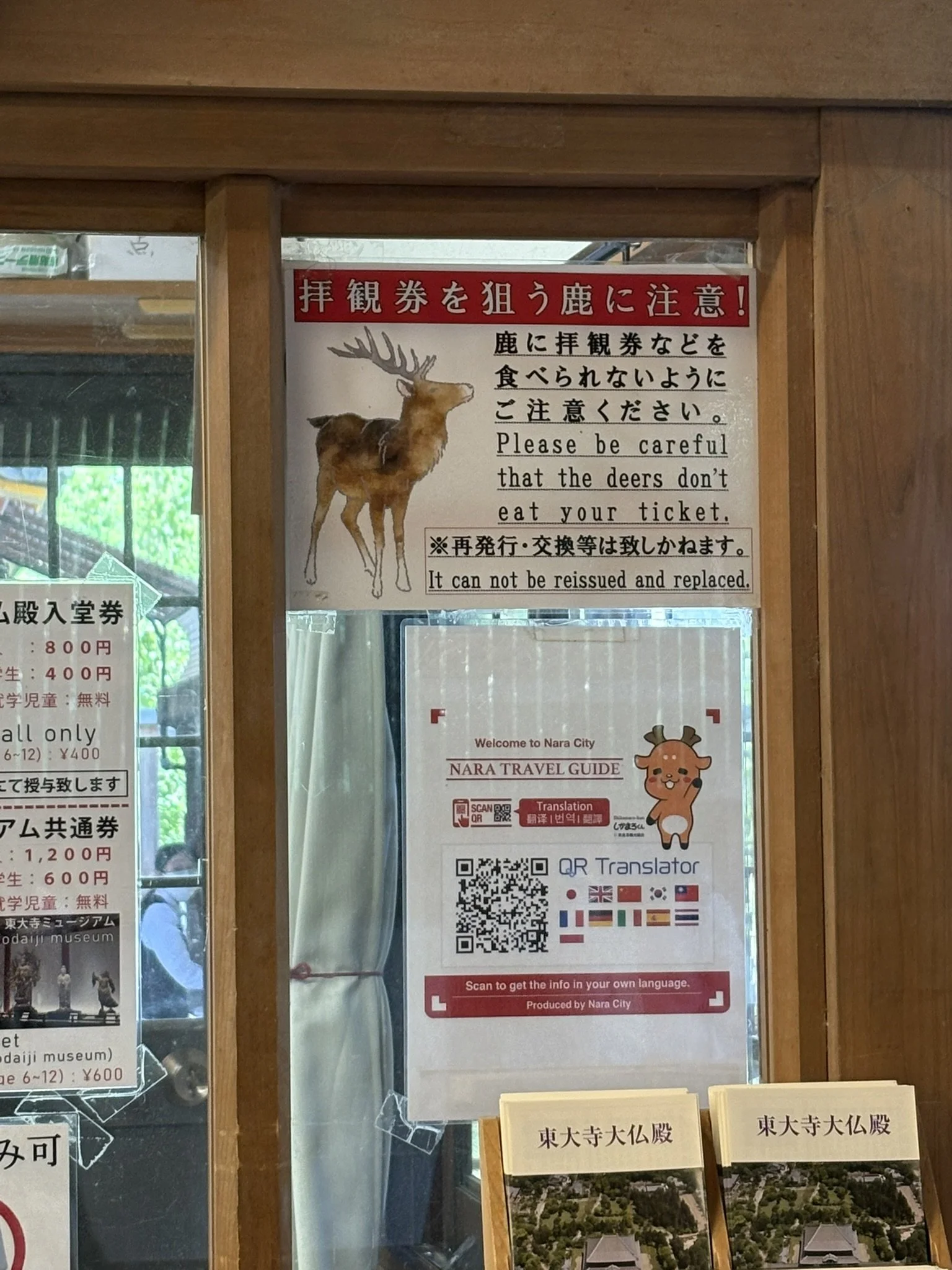
Deeply unserious place.
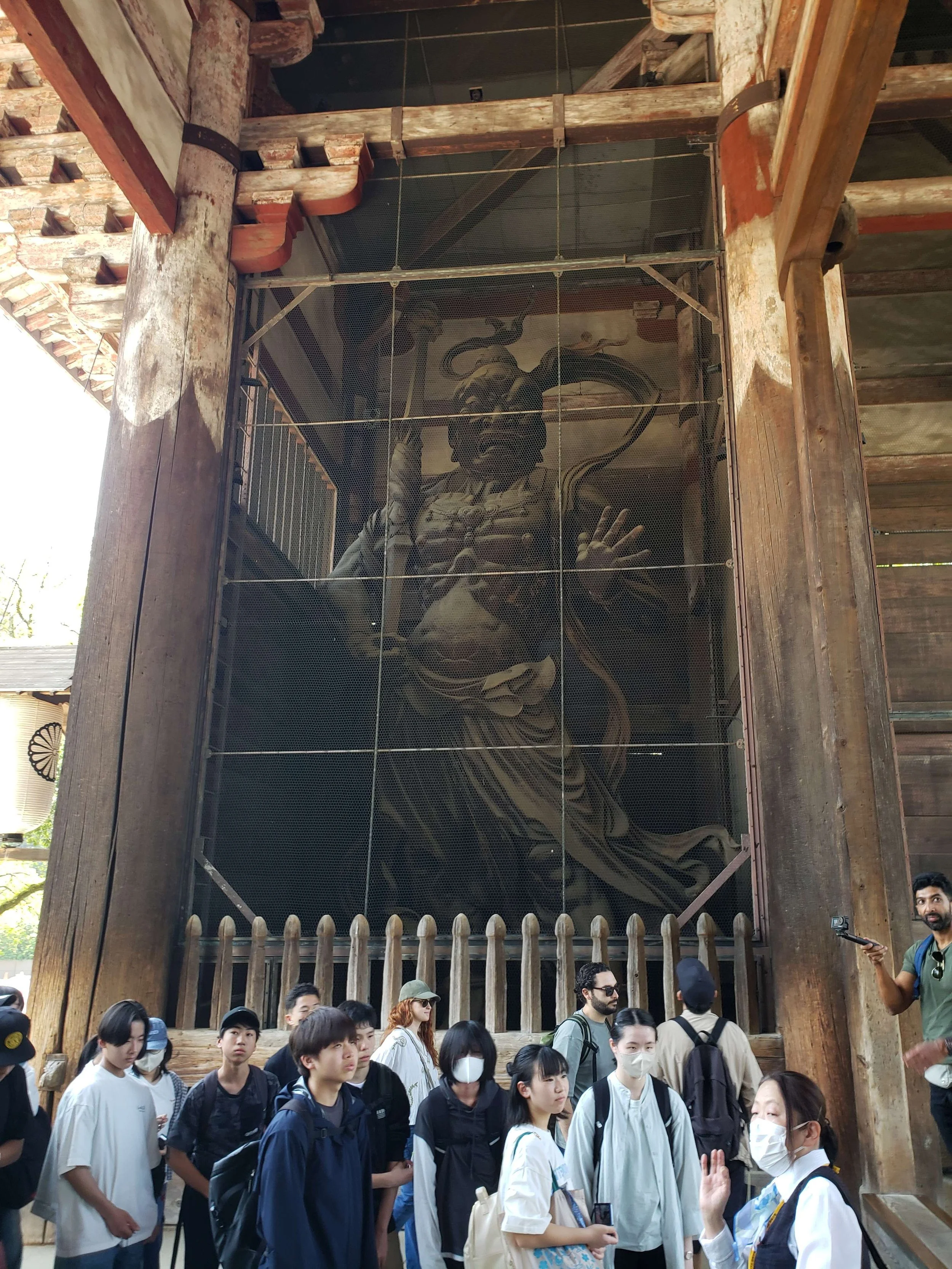
Two giant wooden sculptures guard the gate to Todai-ji. It’s said they were completed in only 69 days, probably because an entire team of people worked on them instead of using the, “One guy does this for 15 years” method used in medieval Europe.
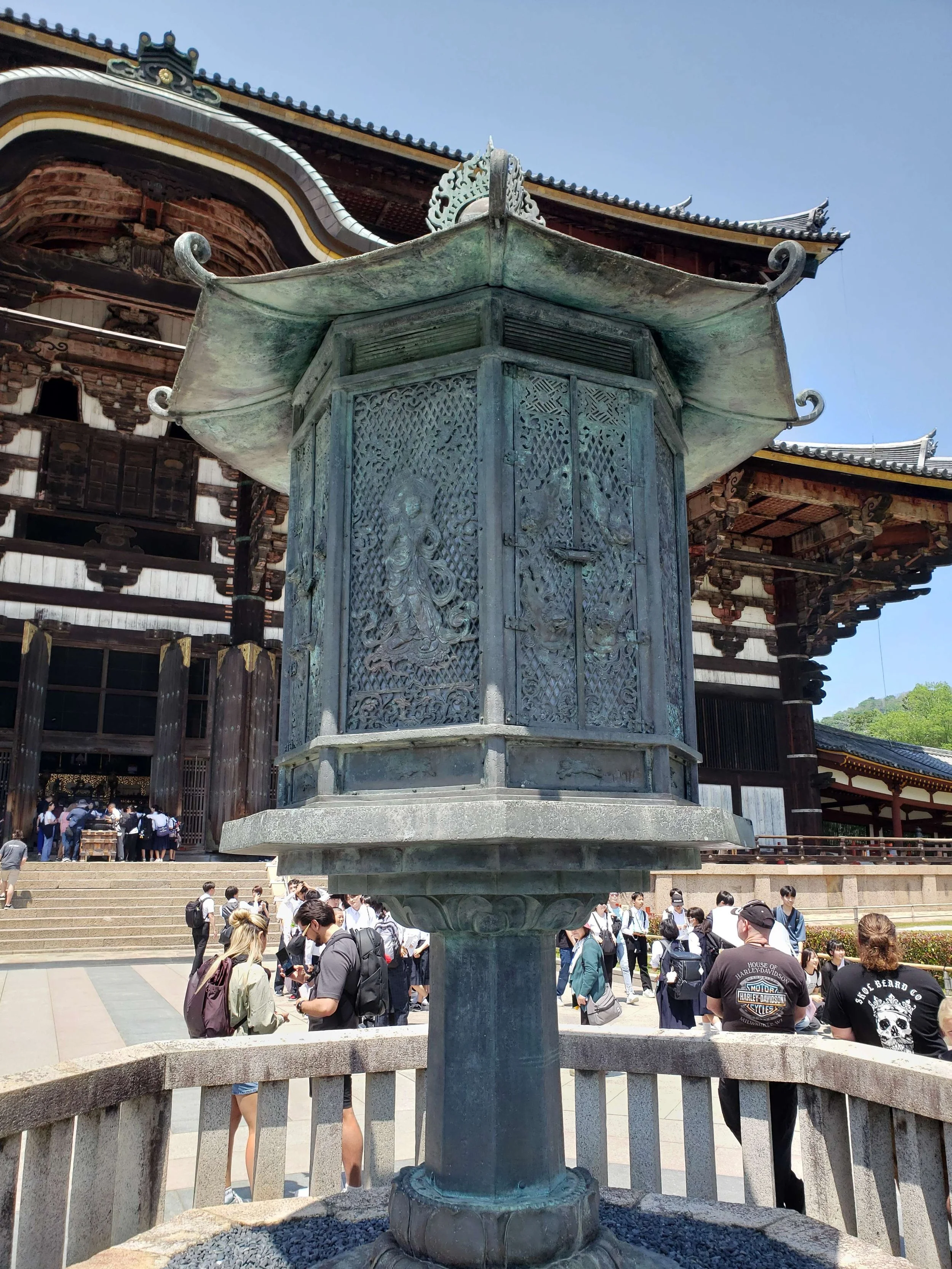
An original lantern from the 8th century. It depicts celestial musicians playing in the heavens.
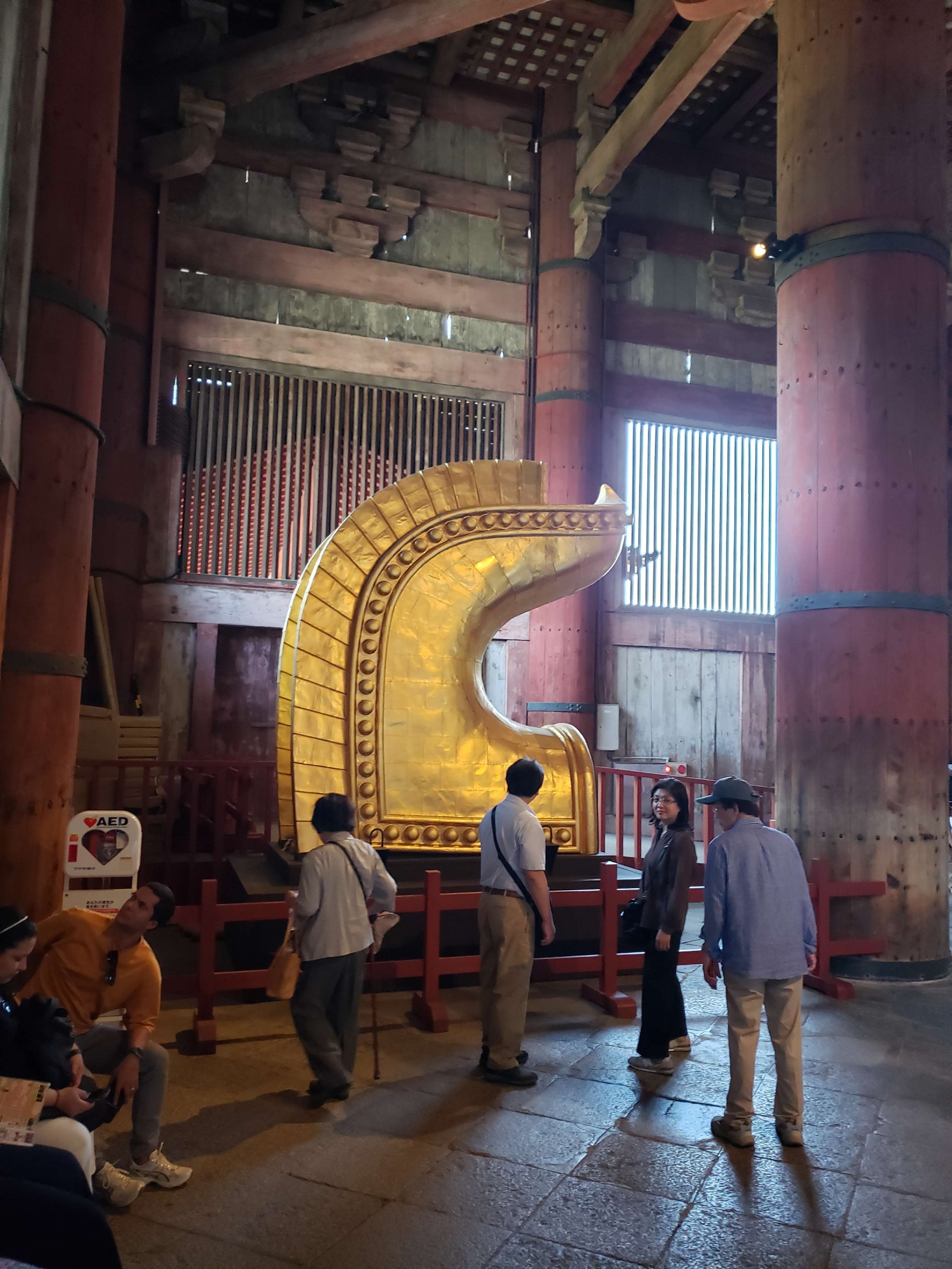
A copy of one of the fish tails on the roof (the ones that apparently do not work at all to prevent fires).
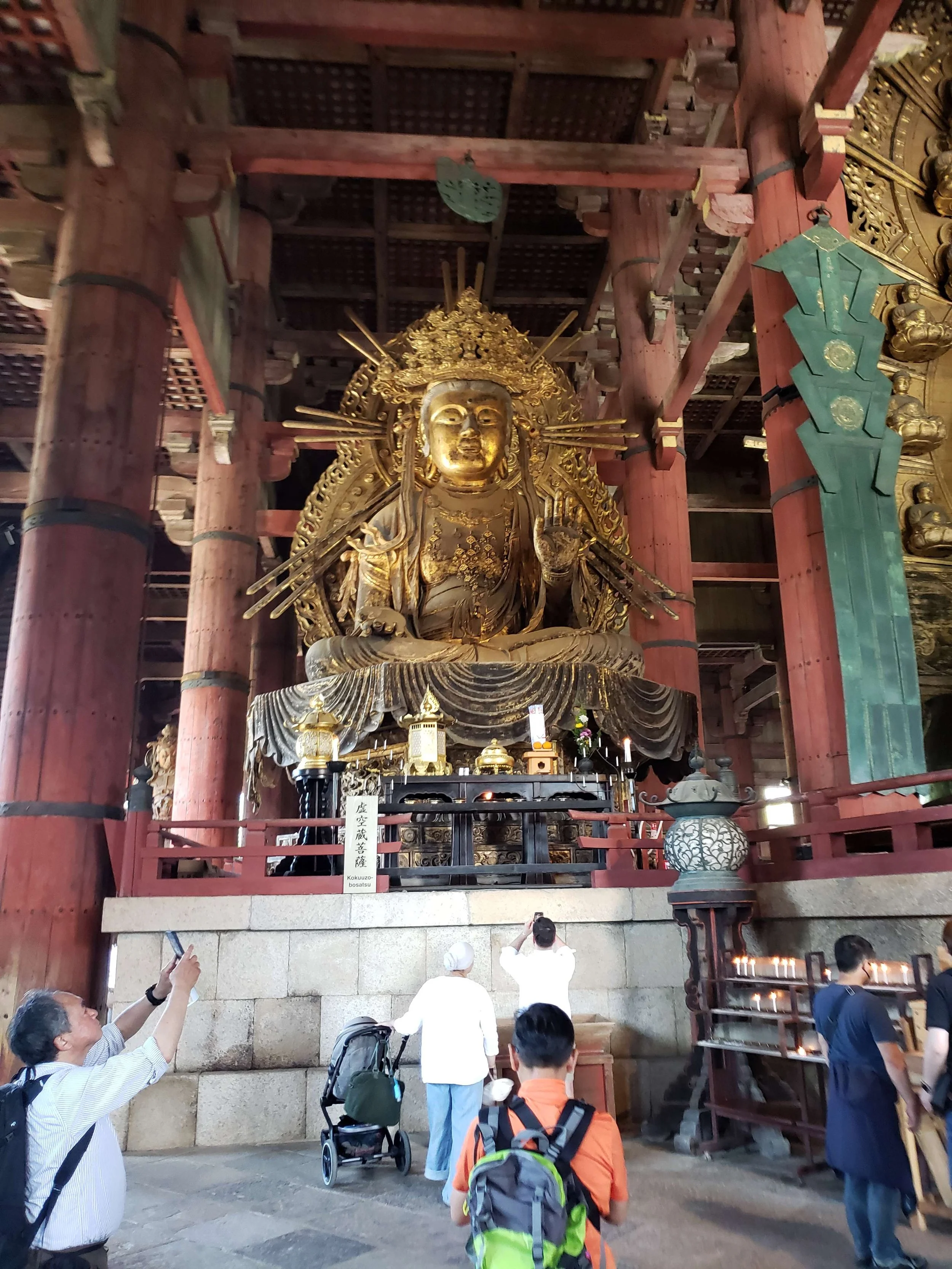
Two Bodhisattvas (enlightened beings who have chosen to delay their own entry into nirvana to help others achieve enlightenment) flank the Buddha statue.
Todai-ji Temple
Todai-ji (“Great Eastern Temple”) is one of Japan’s most famous temples. It houses the world’s largest bronze statue of the Buddha—the statue itself is about 50 feet tall, and the golden halo around him is almost 90 feet in diameter. The statue depicts the Buddha in enlightenment, sitting upon a lotus flower, transcending space and time.
Pictures don’t really do it justice, so just take my word for it: it is BIG and extremely impressive to behold.
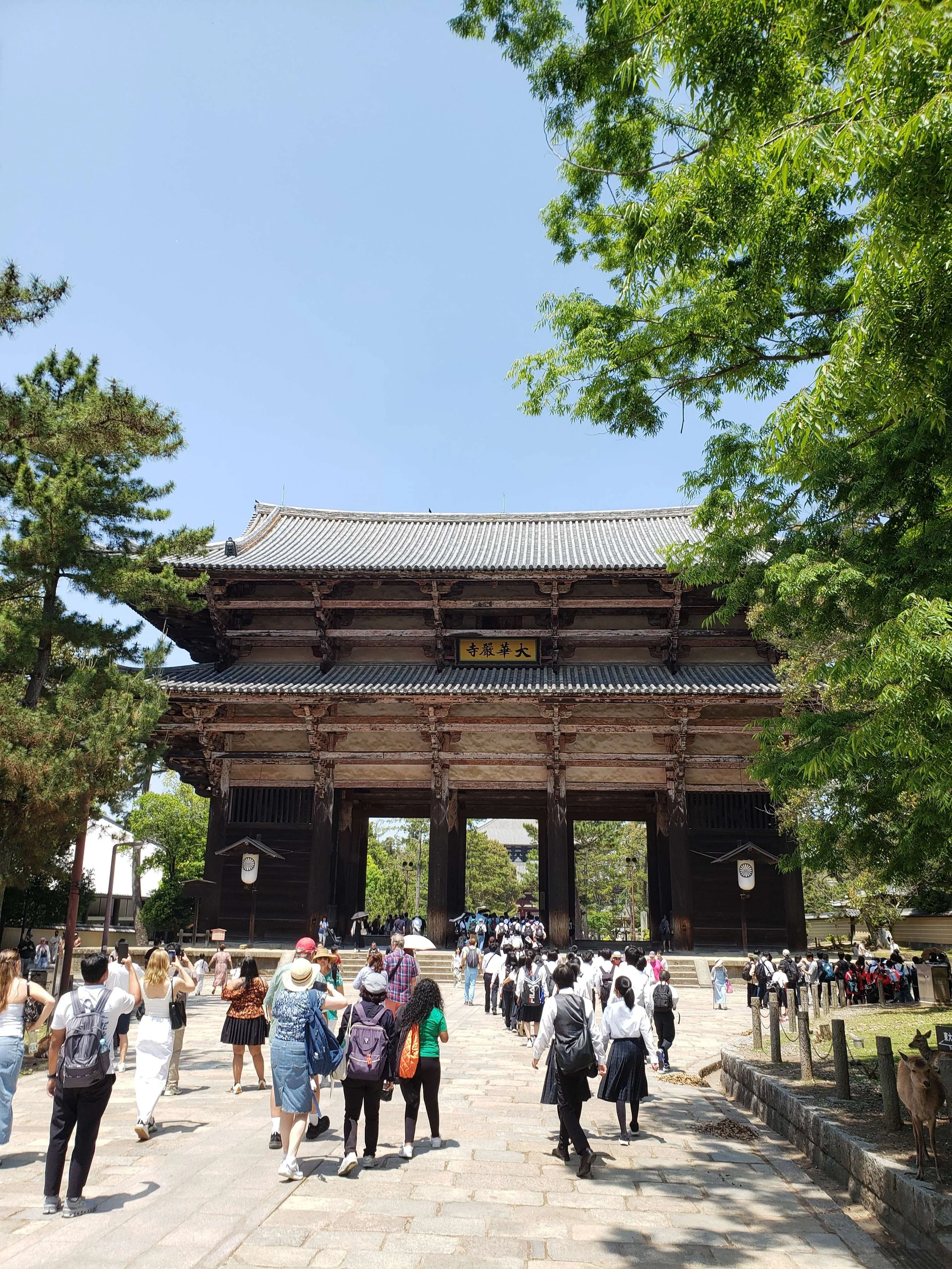
Nandaimon Gate, the entrance to Todai-ji Temple, is one of the largest temple gates in Japan. It was originally built in 752, destroyed by a typhoon in 962 (not a fire! plot twist!) and rebuilt in 1203.
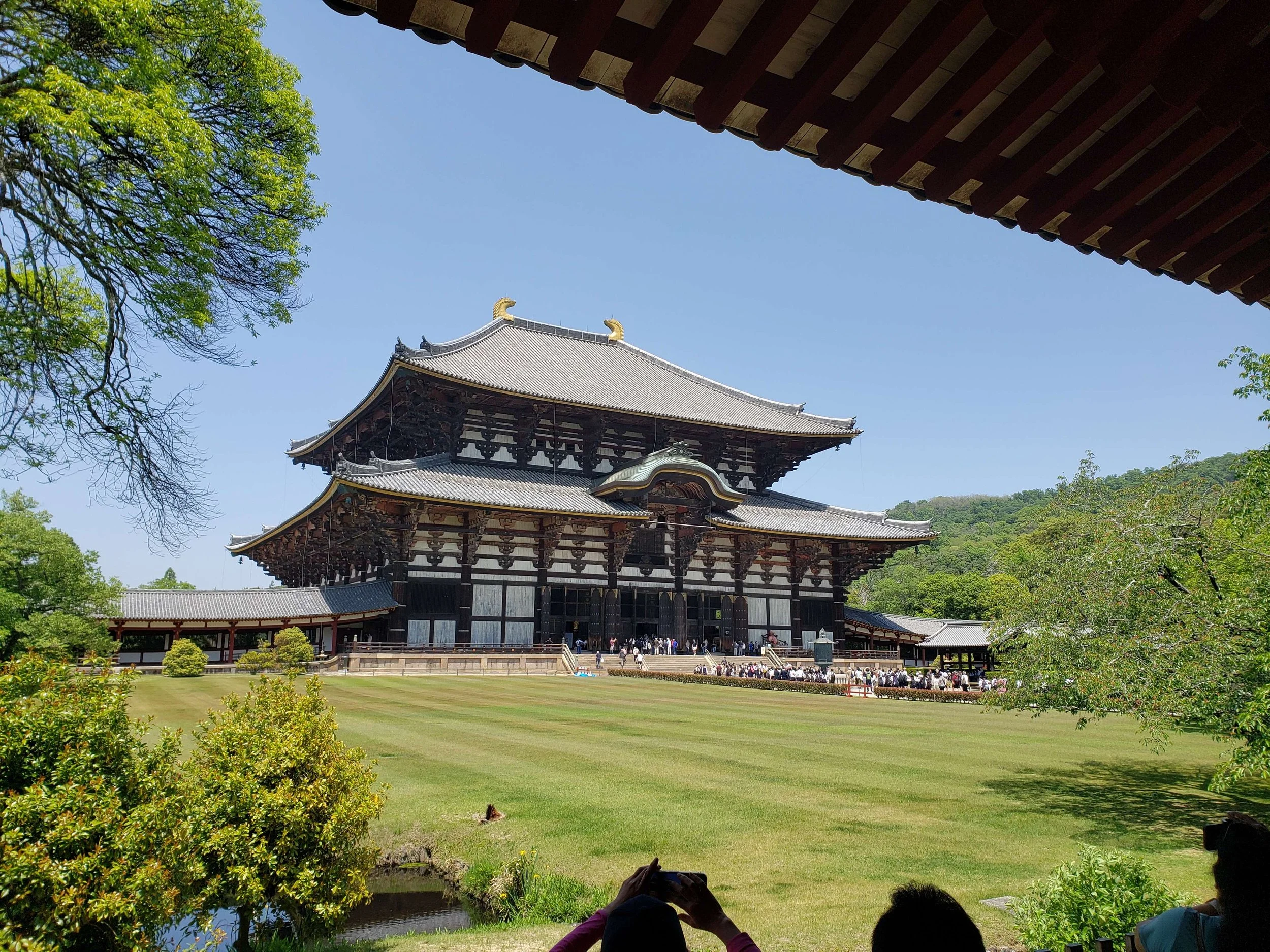
The temple hall used to be even larger, but the original burned down in the 1600s and they rebuilt it about 30% smaller due to cost.
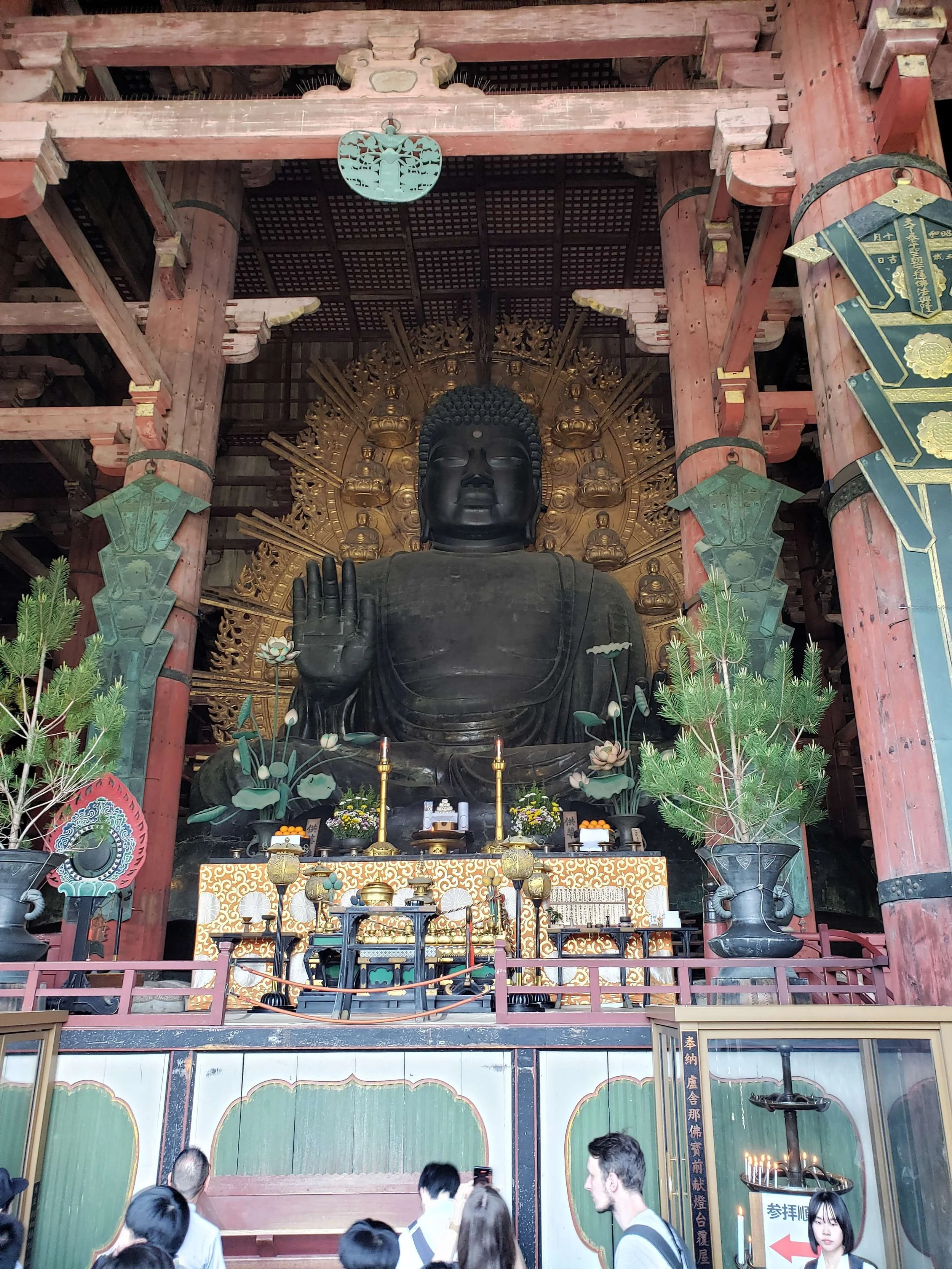
The giant statue of the Buddha is the original, as it survived the fire.
It was here that our guide really paid off. I could tell you just about everything you’d ever want to know about historic Christian imagery (I was basically Jeff’s personal tour guide when we went to Europe for our honeymoon back in 2018), but I really don’t know much about Eastern religions like Buddhism. I think it’s because there’s so much to know, like if the entry-level knowledge for Catholicism included each of the apostles and most of the major saints. I’m getting the hang of it now, though.
One thing our guide explained was that Shinto and Buddhism exist in tandem in Japan, and most holy places will intermix traditions and symbols of each. Polytheistic religions, by design, acknowledge the existence of tons of different deities, so they’re not exclusive the way the way the monotheistic Abrahamic religions are.
She also pointed out a lot of the iconography and what they mean in Japanese culture (lotus flowers for spiritual awakening, butterflies for rebirth and transformation, citrus fruits to represent happiness and generosity).
The hall also features impressive statues of the Four Heavenly Kings, four devas who are believed to each guard one cardinal direction of the world. They’re standard in Chinese Buddhist temples, but you’ll see them all over in Japan, too.
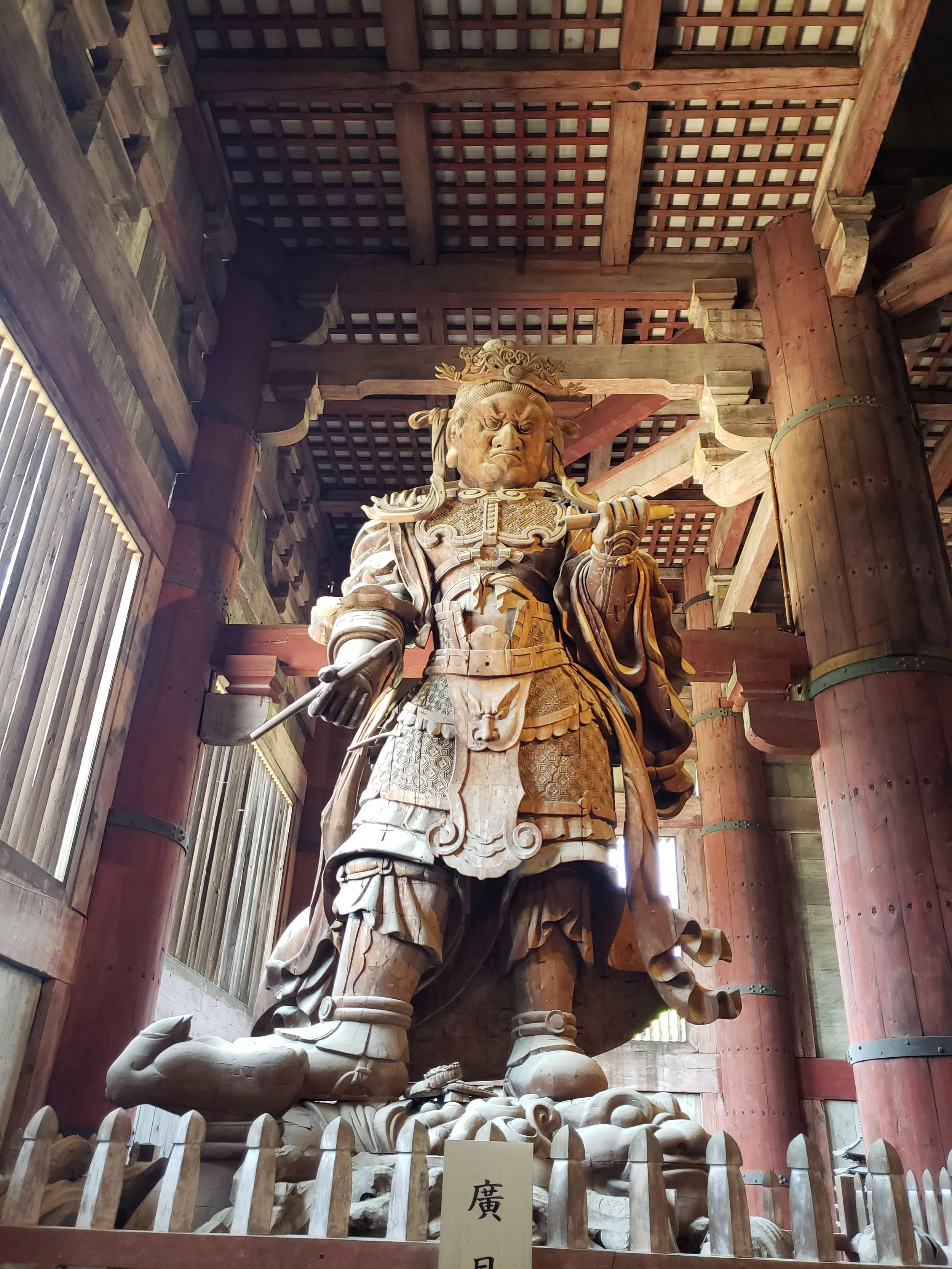
Komokuten of the West (in Japan, represents autumn, the color white, and the ability to see through evil).
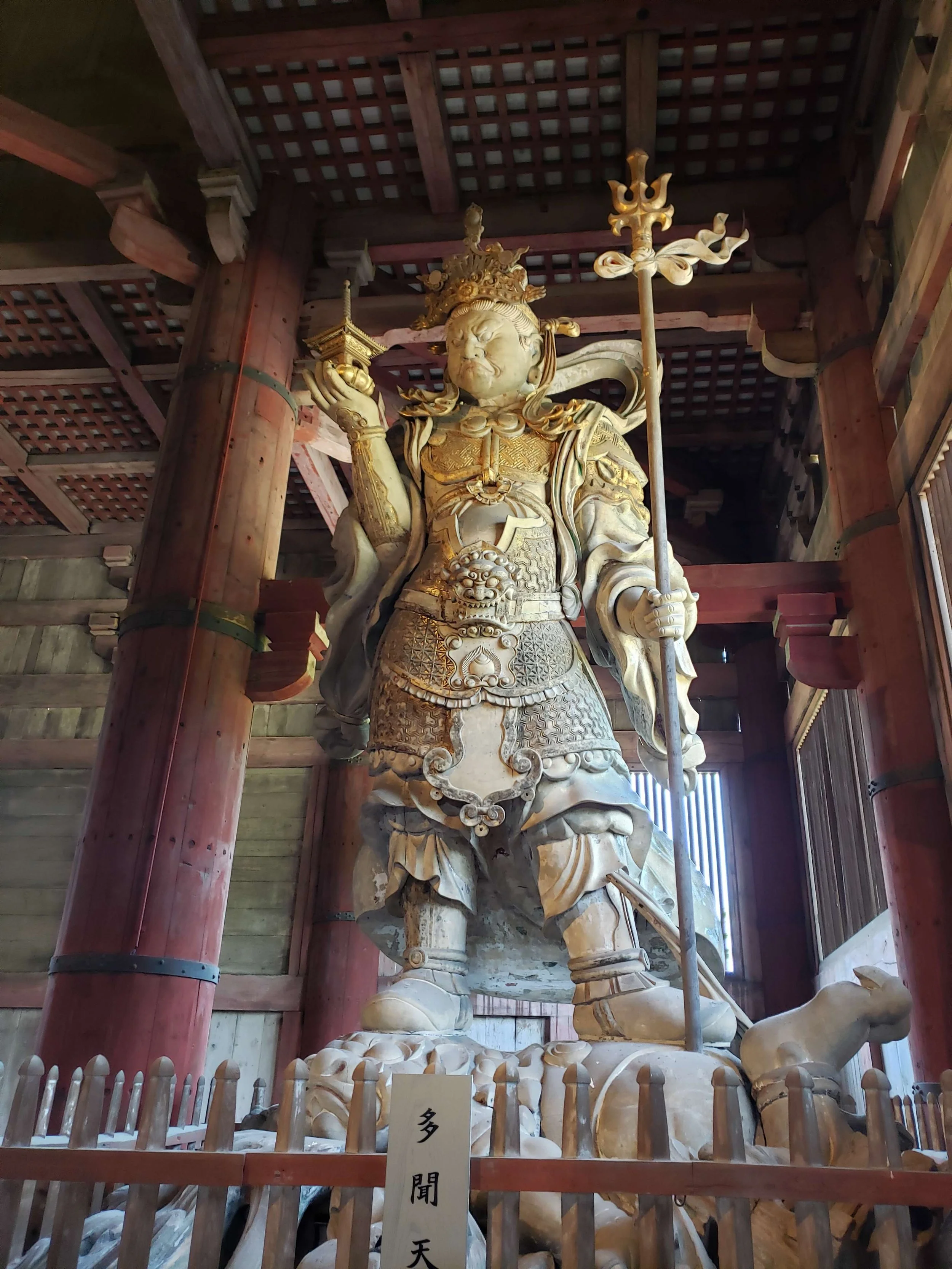
Tamonten of the North (in Japan, represents winter, the colors white/black, and wealth and the spread of Buddhist teachings)
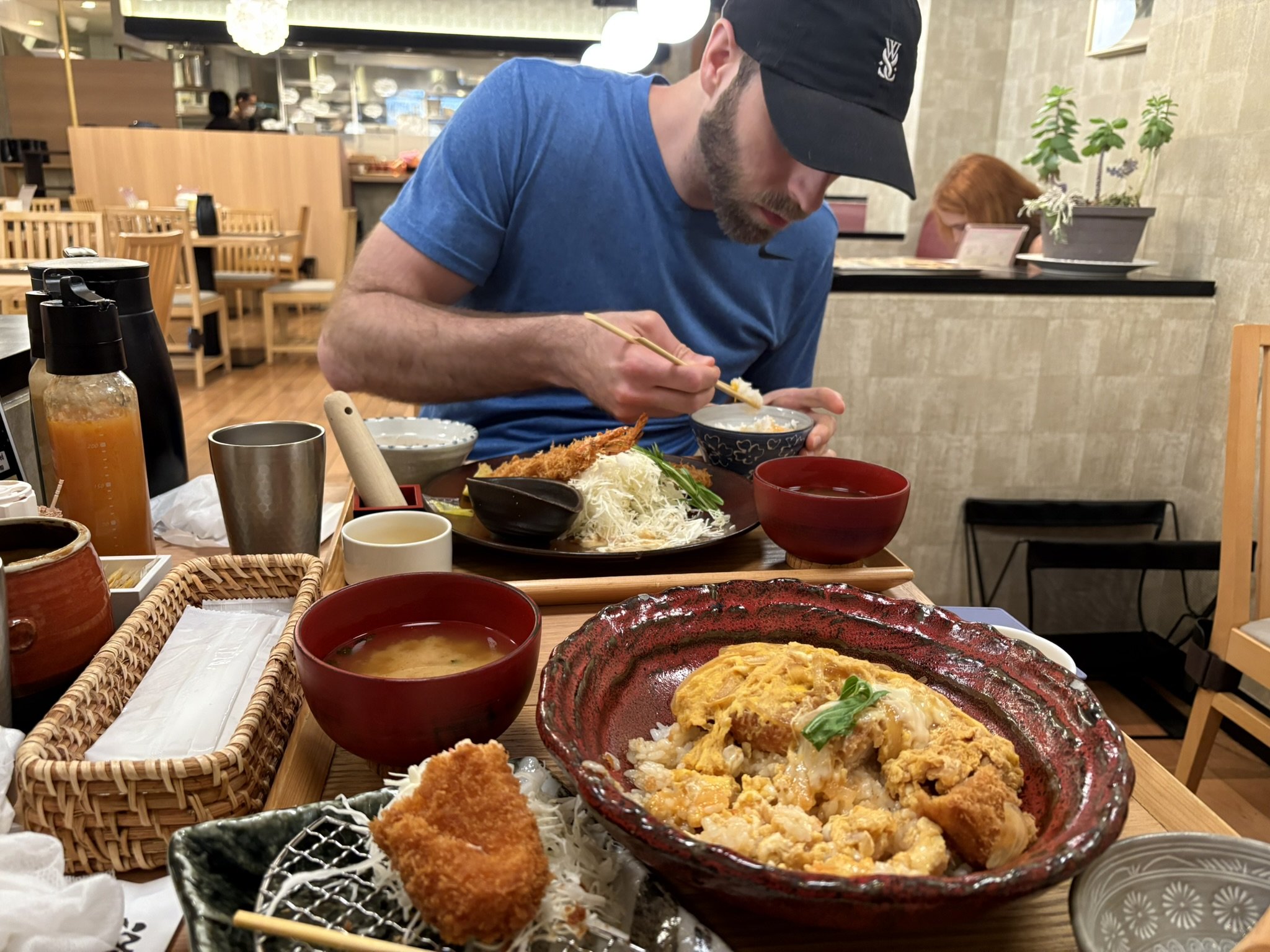
Jeff got pork tonkatsu curry; I got a dish with egg topping. Lots of dishes in Japan are served up with scrambly eggs on top, and I love it.
Evening in Kyoto
We grabbed pork tonkatsu (pork cutlet) at a well-known chain in Nara for lunch, then headed back to Kyoto.
Since we’d had a few jam-packed days and we were feeling a little tired from walking around in the hot 80 degree sunny weather all day, we had a more low-key evening, with some wandering around shops, some relaxing at the hotel, and a chill dinner.
We were lucky enough to get a spot at a family-owned sushi restaurant without a reservation, and I decided to try sea urchin sushi for the first time. The taste/texture combo was, “Cool whip that tastes like the briny air coming off an ocean pier.”
I’m glad I tried it, but my favorite roe sushi is still tobiko (the little orange eggs from flying fish).
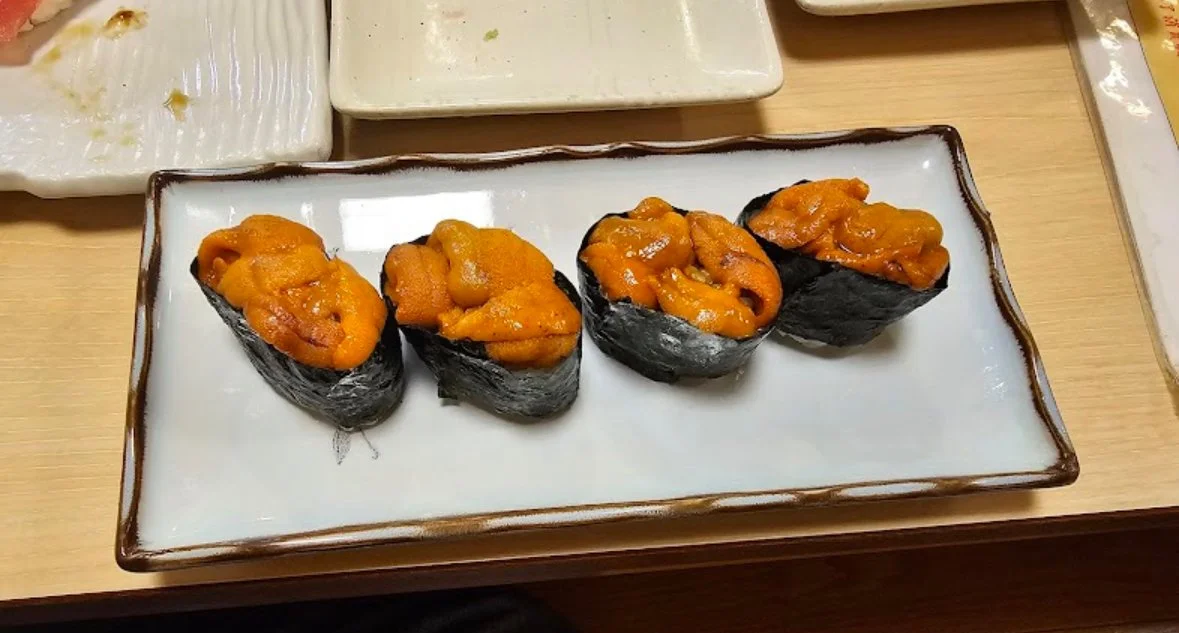
One of the things I wanted to try in Japan was umi, or sea urchin roe sushi. I didn’t realize until I ordered it that it’s not ‘roe’ like tobiko eggs but the reproductive organs of the sea urchin.
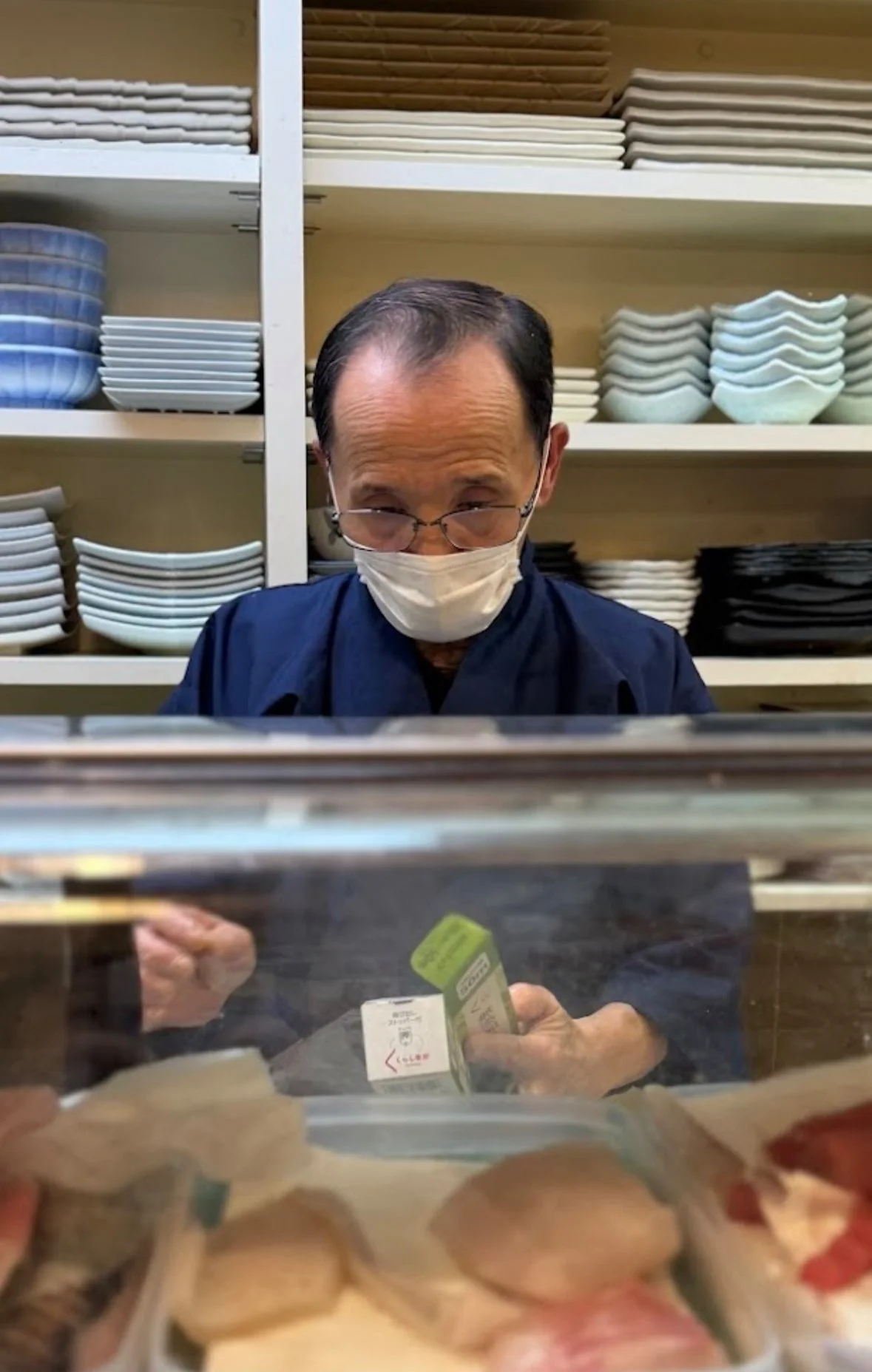
I trusted this nice old man with my life. His sushi was fantastic.
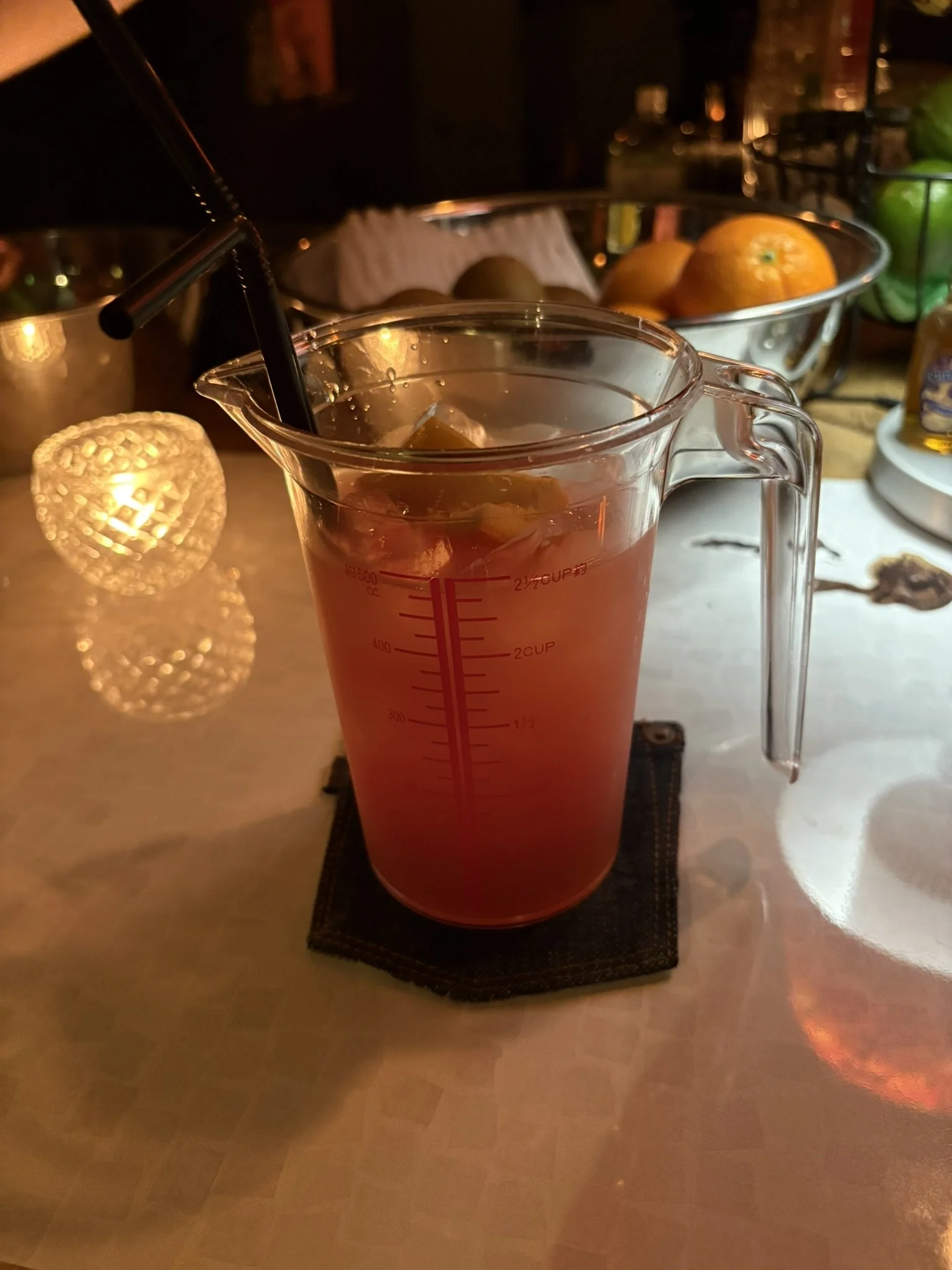
We also went to a tiki bar that had like 8 chairs and really fantastic drinks.
That about covers our first couple days in Kyoto. Next up: Arashiyama and Nijo Castle!